FitWave higher workout consistency designing a personalized fitness app with community and smart reminders
Role
Duration
Team
Platform
Key Metric 1
User personas researched and validated
Key Metric 2
Core problems solved - variety, consistency, gym discovery
Key Metric 3
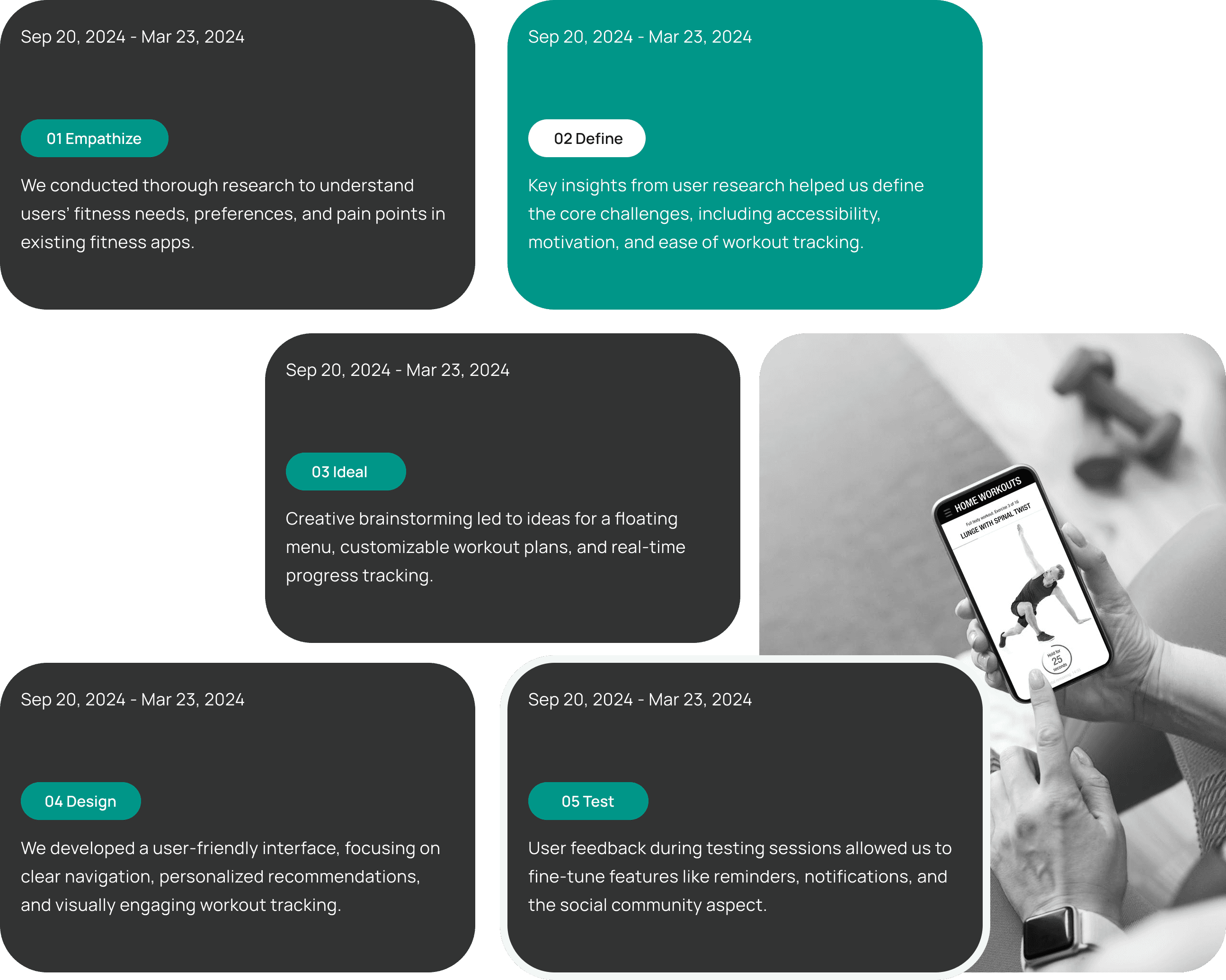
Design process - Empathize, Define, Ideate, Design, Test
Summary
Overview
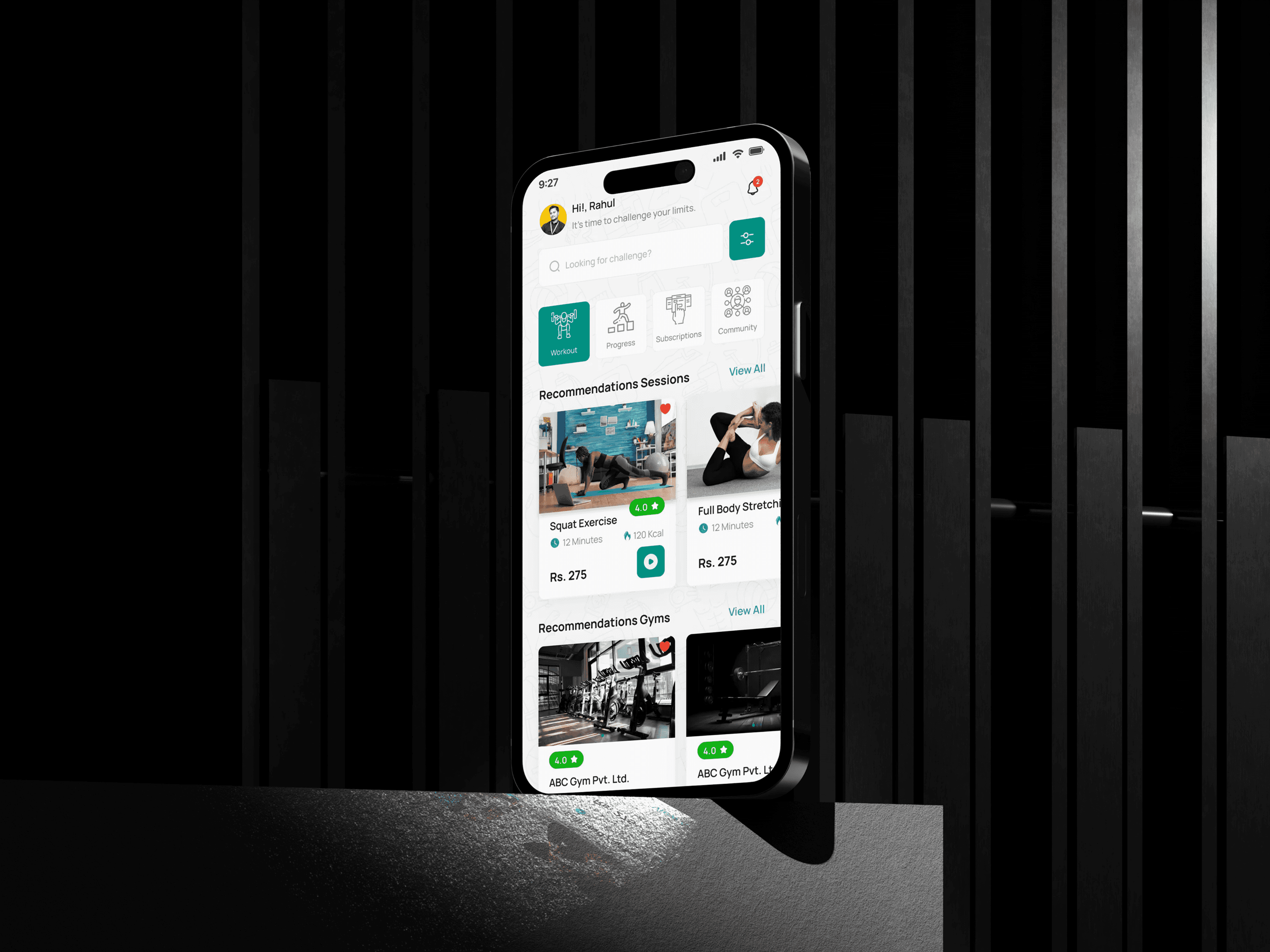
FitWave is a fitness app built around one honest insight - most people don't quit fitness because they're lazy, they quit because their app doesn't fit their life. I designed FitWave's full mobile experience across a five-stage process, covering personalized workout recommendations, session scheduling, location-based gym discovery, progress tracking, and a community challenge layer. User testing confirmed real improvements in session bookings and engagement with personalized features.
Most fitness apps track what you do. FitWave was designed to keep you doing it.
Problem Framing
The Core Problem
Three problems kept surfacing across user research - not enough workout variety for users outside standard routines, no reliable system for staying consistent when motivation dips, and a genuinely frustrating experience trying to find nearby gyms that matched individual needs. None of these were exotic problems. They were the exact reasons people uninstall fitness apps after two weeks.
Why it mattered
Retention is the only metric that matters in fitness apps. An app someone opens once, gets overwhelmed by, and deletes has zero value, regardless of how many features it has. FitWave needed to solve for the drop-off moments specifically: the Tuesday when you skip, the session you can't find a gym for, the workout plan that stopped feeling relevant after week one.
Supporting data / evidence
User interviews with four distinct profiles, a fitness trainer tracking home workouts, an office manager needing quick sessions around a busy schedule, a college student wanting variety and social connection, and a freelance designer preferring gym-based sessions with easy schedule access. Each persona surfaced a different failure mode in existing apps, but all four pointed back to the same root cause: not enough flexibility, not enough support.
Role & Team
My Role
I owned the full design process, user research, persona development, user flow, design system, typography and color system, and all final UI screens. I also led the five-stage design sprint structure from Empathize through Test, including facilitating user testing sessions that shaped the final feature decisions around reminders and the community module.
Team Composition
Solo designer. FitWave's product team provided the brief, feature priorities, and user access for research and testing rounds.
Stakeholders & decision-makers
FitWave's product leadership. Design decisions, particularly around the floating navigation, reminder system, and community challenge structure, were reviewed and tested with real users before final delivery.
Approach
Strategy & framework
I followed a five-stage design sprint, Empathize, Define, Ideate, Design, Test, and treated each stage as a genuine gate, not a checkbox. The Define stage was where the real work happened. Translating four distinct user personas into three specific, solvable problems gave the Ideate stage actual constraints to work within. Without that definition step, the feature list would have sprawled in directions that didn't actually address why users were dropping off.
Research methods used
In-depth user interviews across four personas covering different fitness contexts and schedules. Behavioral analysis of fitness habits and app usage patterns. Pain point mapping across existing fitness app experiences. User testing sessions during the Test phase covering reminders, notifications, and the social community feature specifically.
Key insight(s)
Flexibility kills drop-off. Every user interviewed, regardless of fitness level or schedule, said the same thing in different words: they needed the app to bend around their life, not the other way around. That insight drove every major design decision, from customizable workout plans to the reminder system to the floating menu that kept core actions accessible without requiring navigation.
Challenges
Primary challenge
Designing for four genuinely different user types without building four different apps. Maya's home workout tracking needs, James's quick session scheduling, Ava's social challenge features, and Chris's gym discovery tools could easily have pulled the app in four separate directions, each individually justified by research, but collectively incoherent.
How I navigated it
I mapped all four personas against a single user flow before designing any individual feature. Wherever two or more personas shared a need, scheduling, progress tracking, search, I designed one strong solution that served all of them. Where needs genuinely diverged, gym discovery for Chris, community challenges for Ava, I built those as modular layers on top of the shared core, rather than separate sections that fragmented the experience.
What I Did differently
The community and challenge module was refined late in the process based on user testing feedback. I'd build that section into the ideation stage earlier, social features in fitness apps have a specific design logic around motivation and accountability that deserves its own research thread, not just a testing round late in the project.
Solution
What I designed
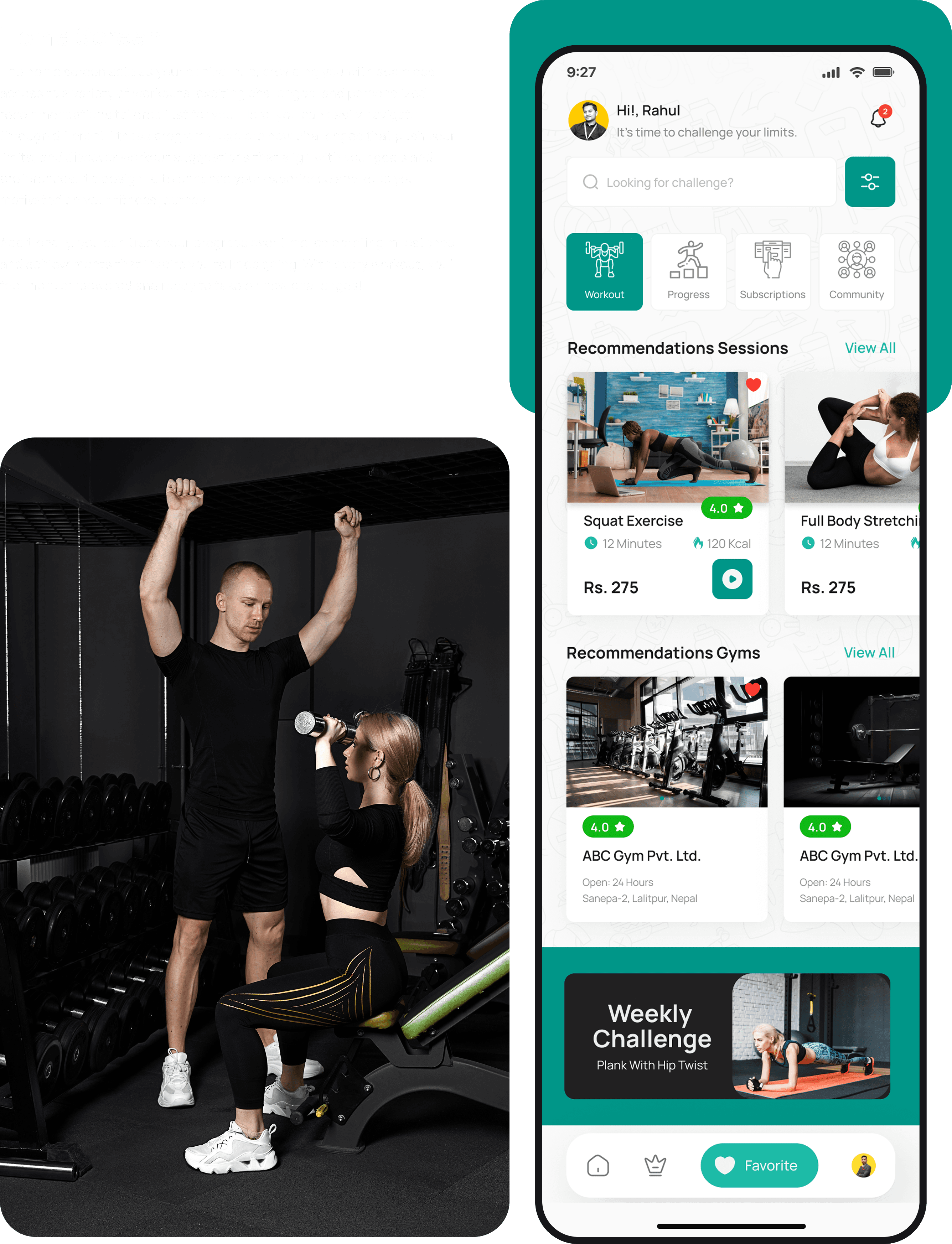
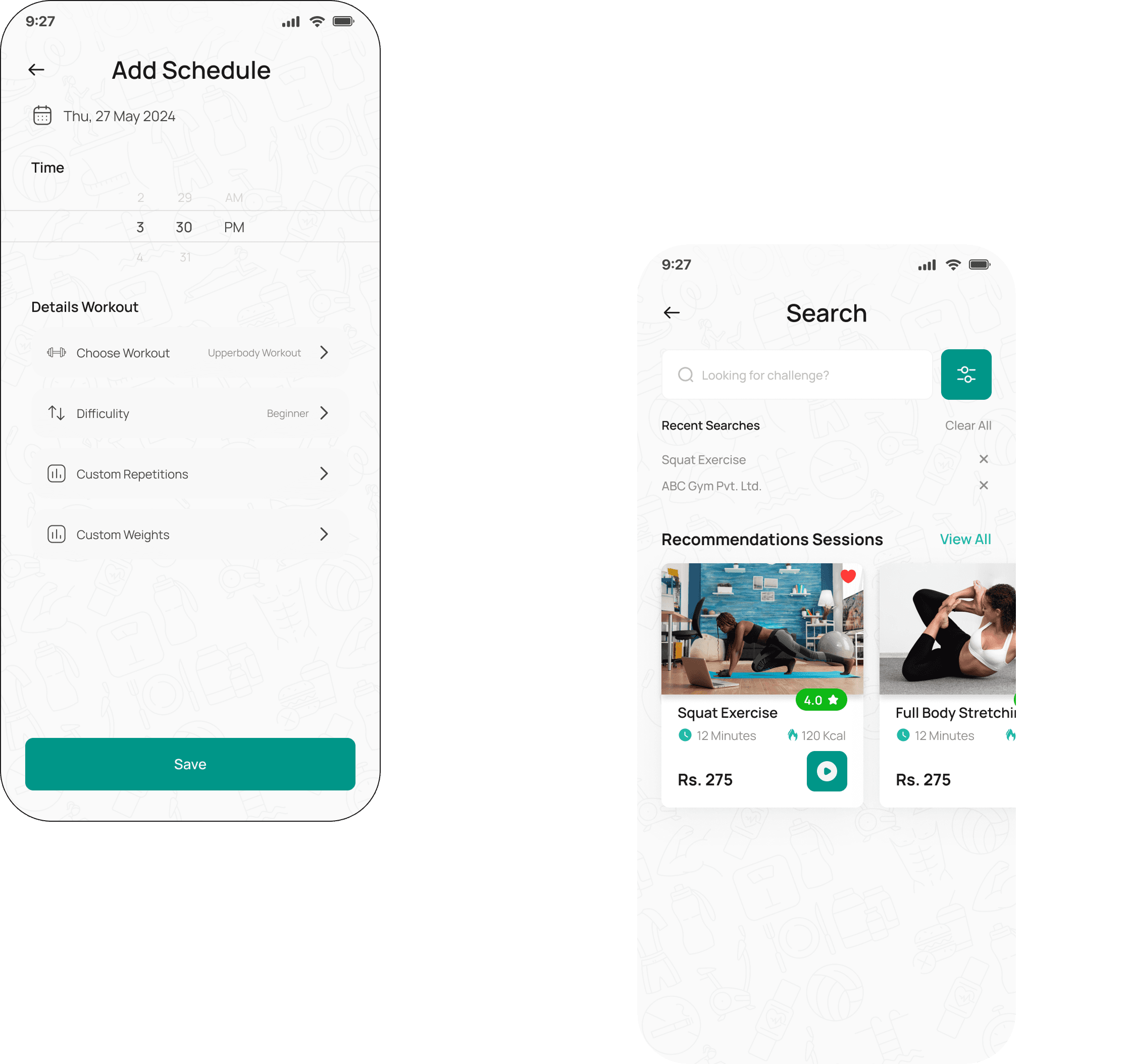
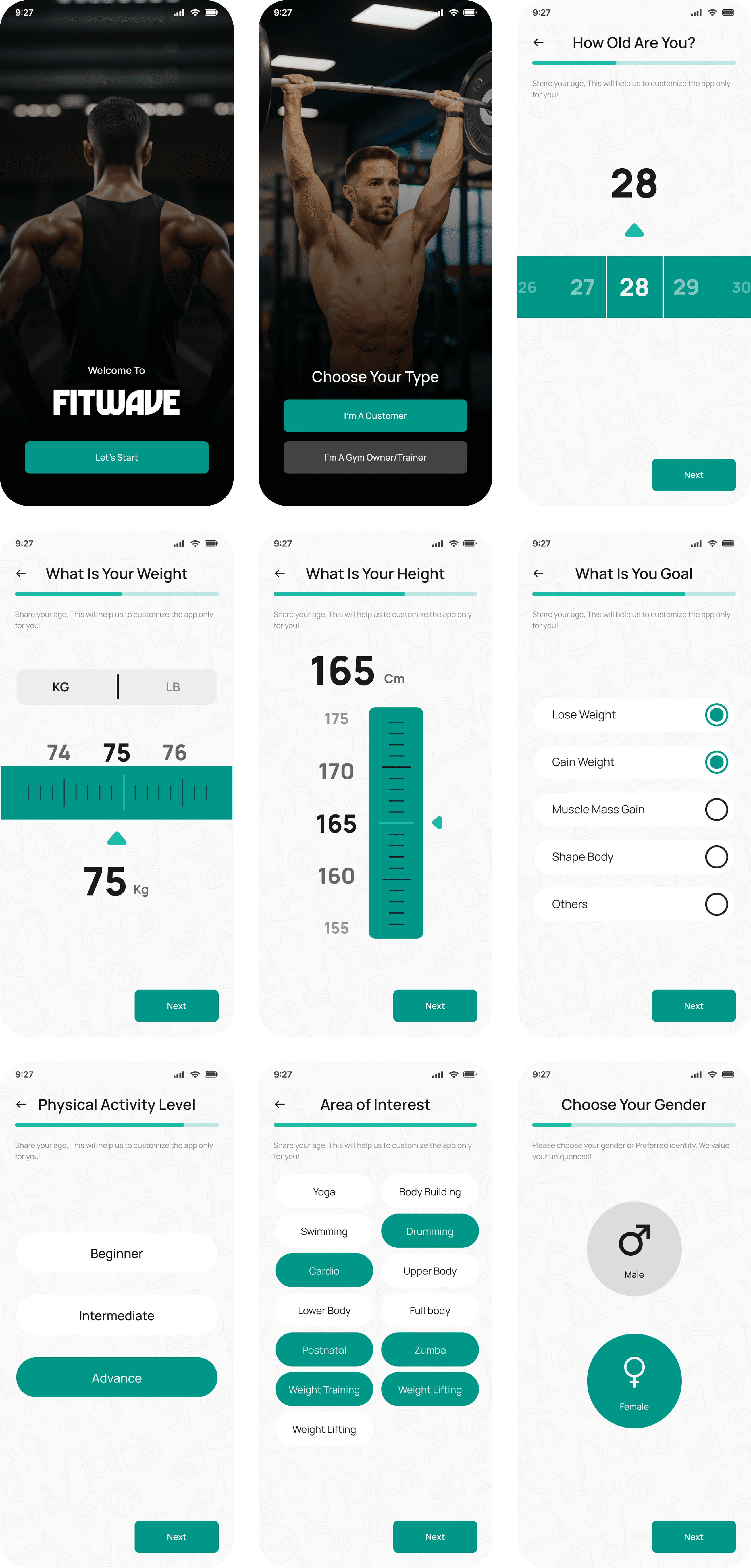
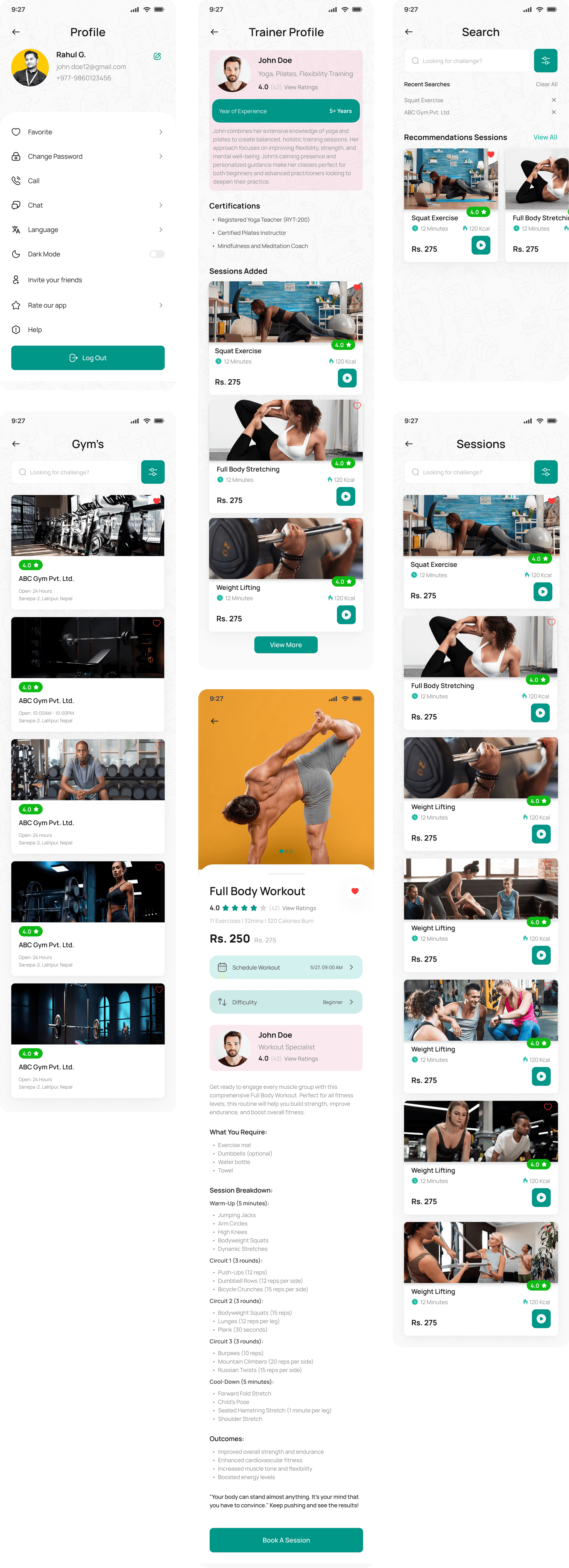
A full mobile fitness app covering five core areas, a home hub dashboard, session scheduling with personalized reminders, workout and gym search, progress tracking, and community challenges. The design system is built on Manrope as the primary typeface and a teal-dominant color palette (#009688, #00433D) that reads as energetic without tipping into the neon-heavy aesthetic most fitness apps default to.
Key design decisions
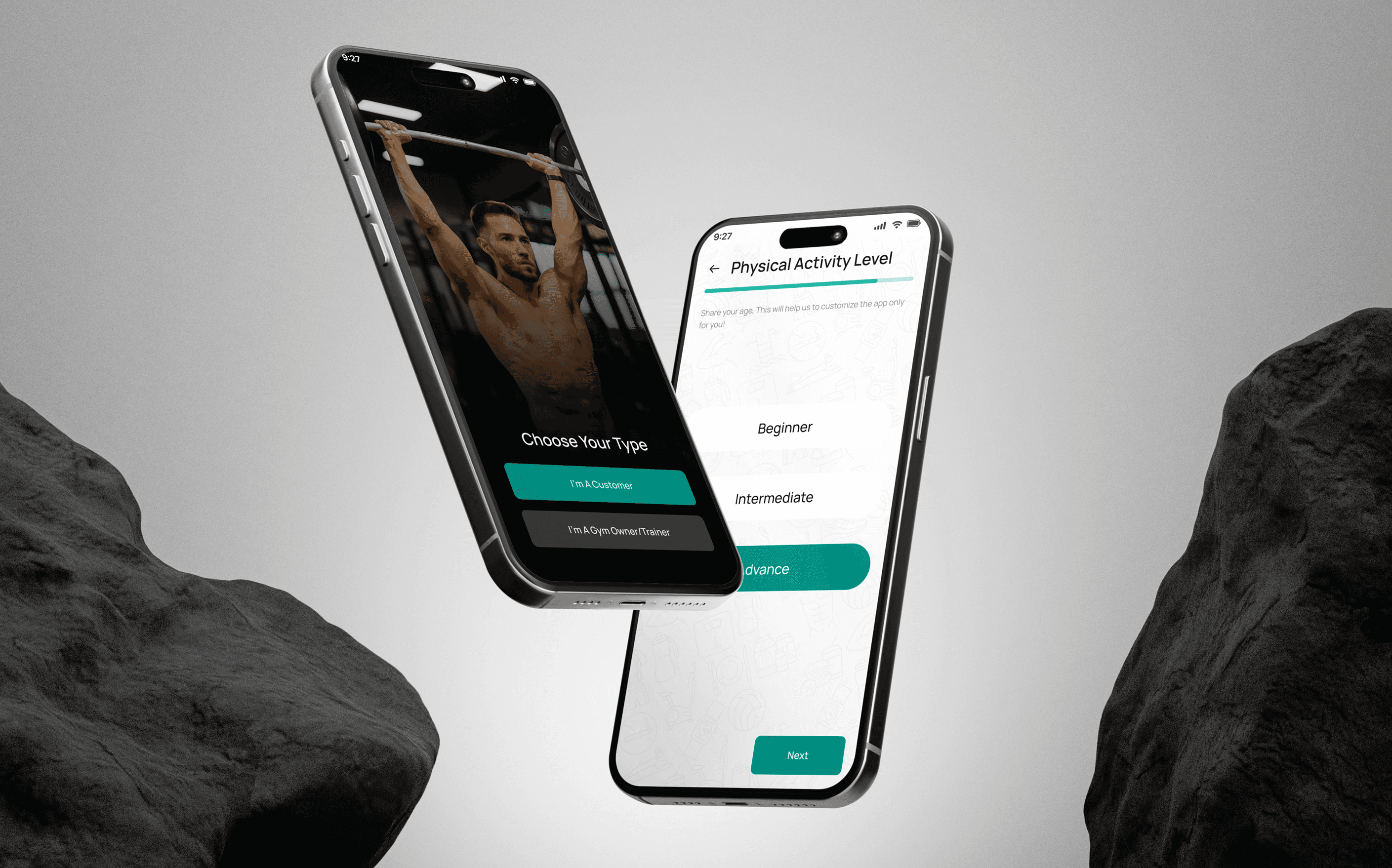
1. Floating navigation menu. Keeping core actions, home, search, schedule, progress, persistently accessible via a floating menu meant users never had to retrace steps mid-session. It was the single most-praised element in user testing, specifically because it reduced the friction of switching between finding a workout and booking it. 2. Reminders as a first-class feature, not a setting. Most apps bury reminder configuration in settings. FitWave surfaced it during onboarding and in the session scheduling flow as a primary action. The testing data confirmed this, users who set reminders had significantly higher return session rates than those who didn't, and making reminders easy to set was a direct driver of that. 3. Location-based gym suggestions integrated into search. Rather than a separate "find a gym" section, gym discovery was woven directly into the workout search flow. A user looking for a session type automatically sees nearby facilities offering it, which is how the decision actually happens in real life.
Results & Impact
Quantitative results
User testing showed a measurable rise in session bookings post-update. Personalized recommendation and reminder features were the two highest-rated elements across testing participants. All four persona types were validated as successfully served by the final design.
Qualitative outcomes
Testing feedback consistently highlighted two things: the app felt genuinely personal, and it was easy to pick back up after a gap. That second point matters more than it sounds, the hardest moment in any fitness routine isn't starting, it's restarting. Users described FitWave as "not making them feel bad for missing a session," which is exactly the tone the design was calibrated to land on.
Business impact
FitWave launched with a design validated to drive the metric that matters most in consumer fitness apps, return usage. The personalization layer, reminder system, and community features all target the drop-off moments that kill retention. The location-based gym discovery adds a utility layer that gives FitWave a practical reason to exist in a user's daily routine, not just during dedicated workout moments.
Next Steps
What's next (and why)
The community challenge module has the most untapped potential in the current build. Social accountability is one of the strongest retention drivers in fitness, users who have a friend or group to check in with stay active longer. Building out challenge creation, leaderboards, and shared progress visibility would be the highest-leverage next phase.
Open questions / hypotheses
Does the personalized recommendation engine actually change what users do, or does it just surface things they would have searched for anyway? That distinction matters for the product roadmap. If it's genuinely changing behavior, it's worth significant further investment. If it's just a better search UI, the team should know that too.
Learnings
This project sharpened something I already suspected, in consumer health apps, tone is a design decision as much as layout is. The color palette, the copy voice, the way reminders are framed, whether the progress screen celebrates or just reports, all of it either adds to or drains from the user's motivation. FitWave worked because the design stayed on the side of the user, not the metric.