Genese GmbH a modern web presence worthy of 25 years of IP expertise a modern web presence worthy of 25 years of IP expertise
Role
Duration
Team
Platform
Key Metric 1
Of market trust - preserved and reframed for a global audience
Key Metric 2
Design-weighted process - heavy visual execution after lean UX
Key Metric 3
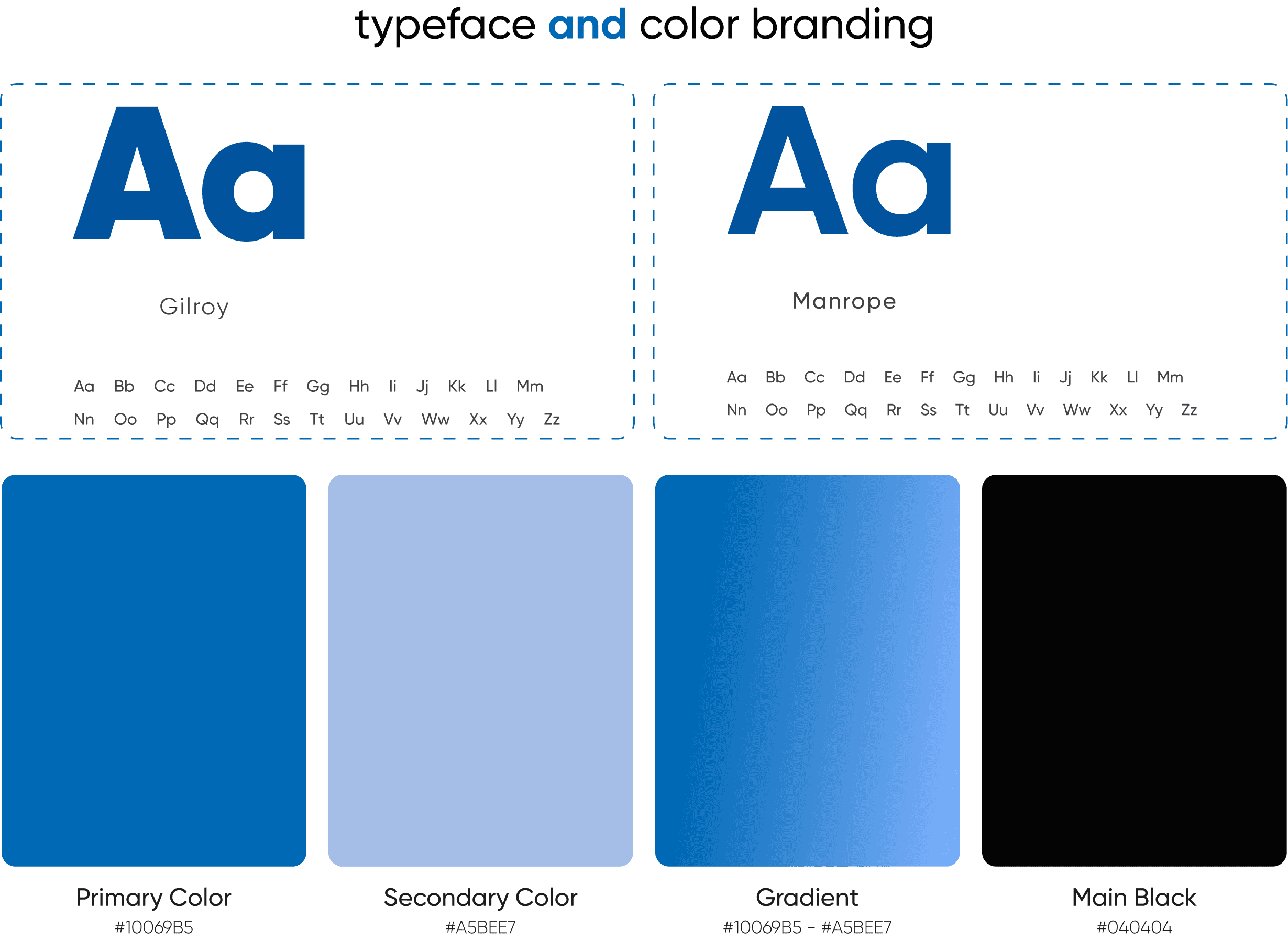
Gilroy + Manrope - paired to balance authority with approachability
Summary
Overview
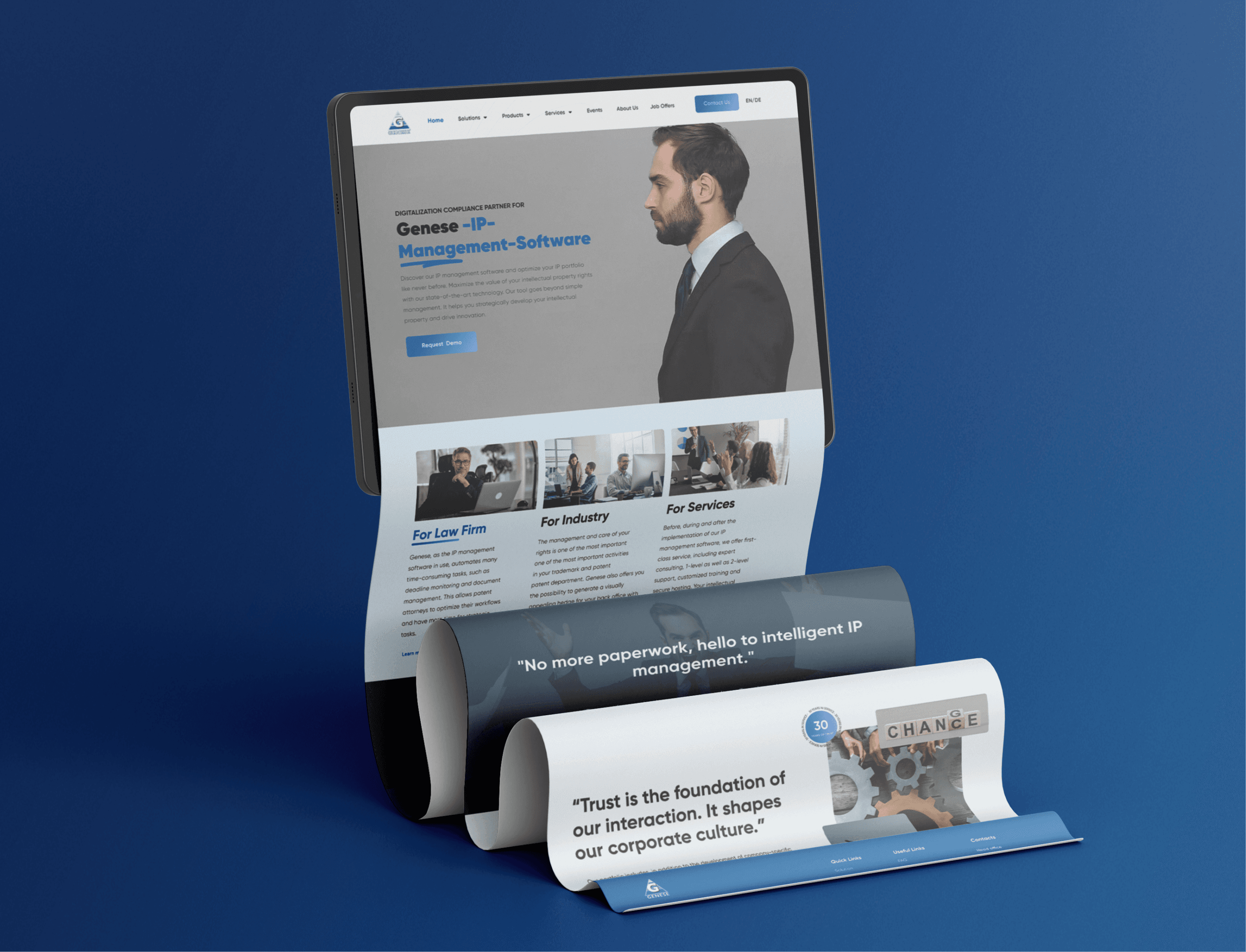
Genese GmbH has been in the IP management software business since 1992. That's 25 years of genuine credibility and a website that wasn't showing any of it. They needed a redesign that didn't just modernise the look, but shifted the whole positioning: away from a company talking about its own history, toward a company that clearly understands what law firms and patent attorneys actually need. I redesigned the full website around that shift human-first framing, clear service communication, and a visual identity that finally matched the quality of the product.
25 years of trust. Zero of it visible on the old website.
Problem Framing
The Core Problem
Genese had the reputation but not the presence. The existing website didn't reflect 25 years of specialised expertise in IP management it looked like a company that had been around for a while but hadn't thought much about how it came across. For a software house competing in a global market, that gap between actual credibility and perceived credibility is a real commercial problem.
Why it mattered
Law firms and patent attorneys evaluating an IP software partner aren't impulse buyers. They're making a considered decision about a long-term relationship. A website that feels dated or generic doesn't just fail to impress it actively raises doubts about whether the software itself has kept pace. Genese had recently introduced new products and technologies. The website needed to reflect that, or the new products would be introduced to prospects who'd already formed a negative first impression.
Supporting data / evidence
The brief identified the gap directly despite being a trusted provider in Germany for 25 years, Genese lacked a professional, contemporary web presence that could stand up in the global market. Internal review had already concluded the existing site was failing to communicate the company's recent product development and innovation. The redesign mandate was explicit: shift from dwelling on history to demonstrating current capability, and put people not software features at the centre of the story.
Role & Team
My Role
Solo designer across the full project UX, UI, prototyping, and visual branding decisions. The design process was weighted heavily toward UI execution (55%) after a lean UX phase (24%), with prototyping (11%) and testing (10%) completing the sprint. That ratio reflected the nature of the project the UX problems were well-defined from the brief, and the majority of the work was translating that clarity into a visual identity that could carry Genese's positioning convincingly.
Team Composition
Solo designer. Genese's internal team provided the brand brief, content direction, product and service detail, and feedback throughout the process.
Stakeholders & decision-makers
Genese GmbH's product and marketing leadership in Bremen. Design decisions — particularly around the balance between legacy and innovation in the homepage narrative were reviewed directly with the client.
Approach
Strategy & framework
The strategic brief was unusually clear: stop leading with history, start leading with people. Genese's existing positioning leaned heavily on "25 years of experience" as the main value signal which is credible but passive. The redesign reframed that to "here's what we actually do for law firms today, backed by 25 years of knowing how." That's a different story, and it required a different visual and structural logic to tell it.
Research methods used
Brief analysis and stakeholder intent mapping to define the positioning shift. Competitive review of comparable IP management software providers in the German and European market. Content audit of existing pages to identify what was working and what was undermining the credibility signal. Visual direction exploration across typeface pairing, color system, and layout hierarchy to find the aesthetic register that sat between "established German software company" and "modern, forward-looking technology partner."
Key insight(s)
The 25-year legacy wasn't the problem how it was being used was. History framed as "we've been around a long time" is inert. History framed as "we've been inside law firms and patent offices long enough to understand them completely" is a genuine differentiator. That reframe changed the homepage hierarchy, the tone of the copy sections, and the way the company philosophy was presented from a historical statement to an active value claim.
Challenges
Primary challenge
Redesigning for a company that had been doing things the same way for 25 years, where the instinct was to protect the legacy rather than evolve it. The brief asked for both maintain the ongoing legacy and introduce a clear distinction that signals advancement. Those two things pull in opposite directions if you're not careful, and the design had to hold the tension between them without collapsing into either a nostalgia piece or a rebrand that felt disconnected from who Genese actually is.
How I navigated it
The visual identity anchored the solution. Gilroy handled the display and heading work geometric, confident, modern while Manrope carried the body text with warmth and readability. The primary blue (#10069B5) gradient maintained Genese's established color territory while the gradient treatment gave it forward momentum rather than static familiarity. The combination reads as "the same company, but they've clearly been thinking about where they're going."
What I Did differently
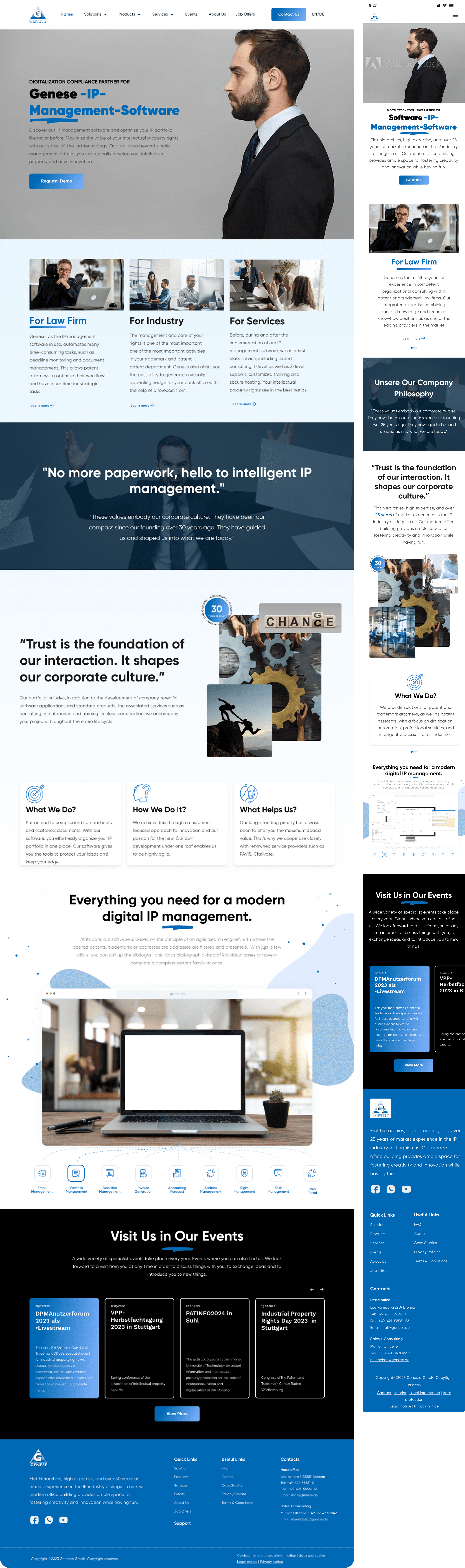
The events section showcasing industry conferences and specialist events where Genese appears deserved more design investment than the current build gives it. For a company whose client relationships are built on deep industry presence and face-to-face credibility, the events section is a genuine trust signal. Treating it as a standard content module undersells what it's actually communicating to a prospect who's evaluating whether Genese is a serious player in the IP space.
Solution
What I designed
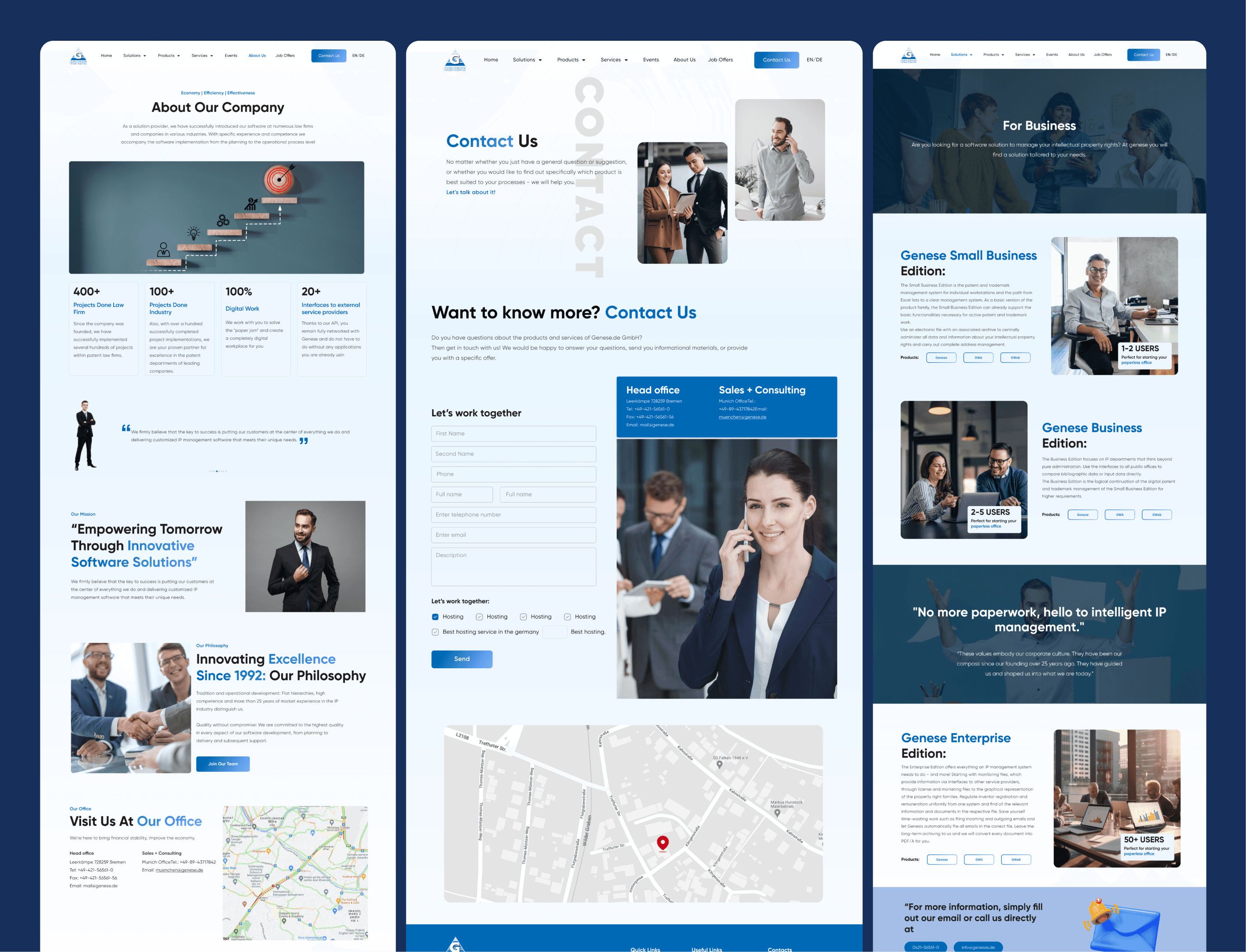
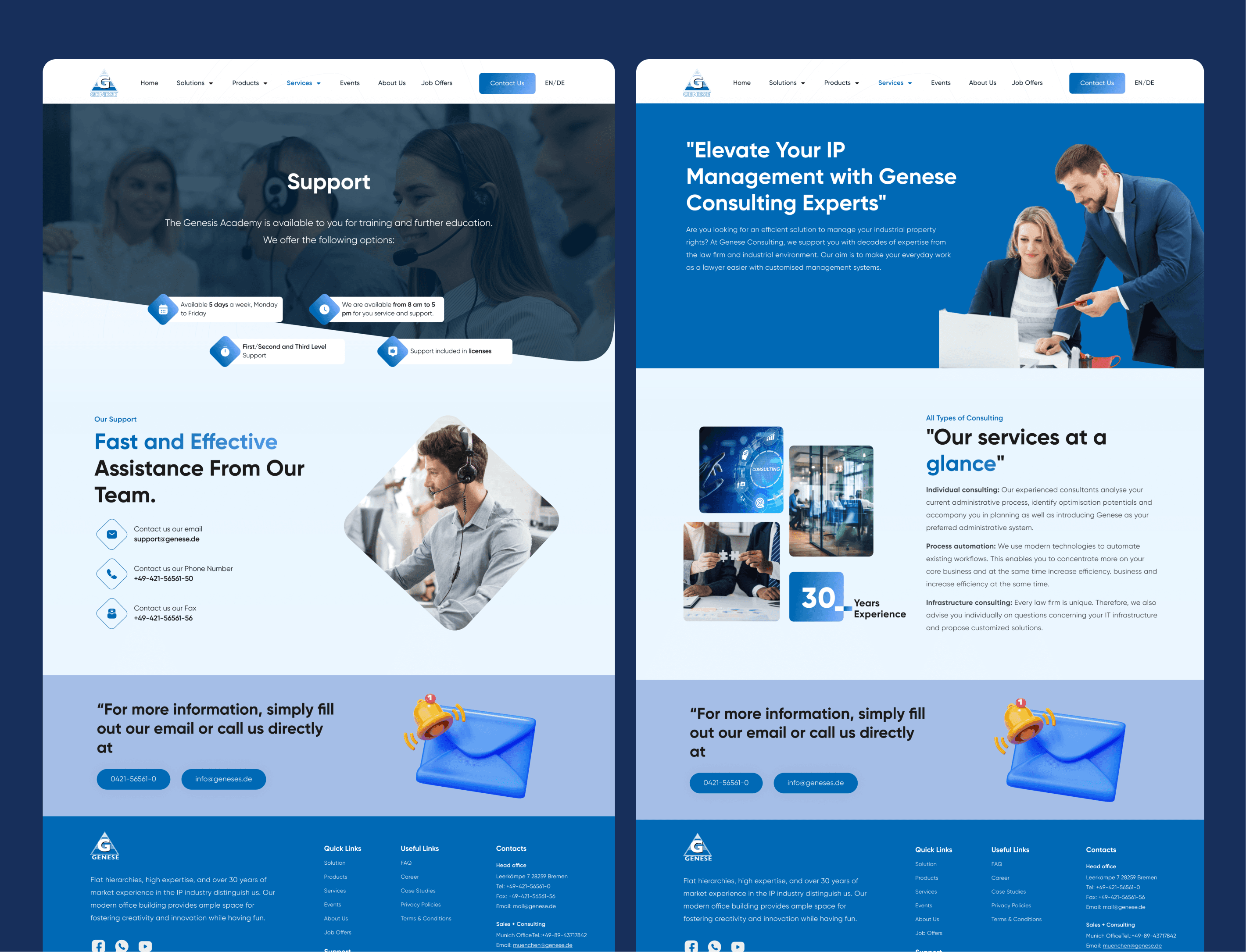
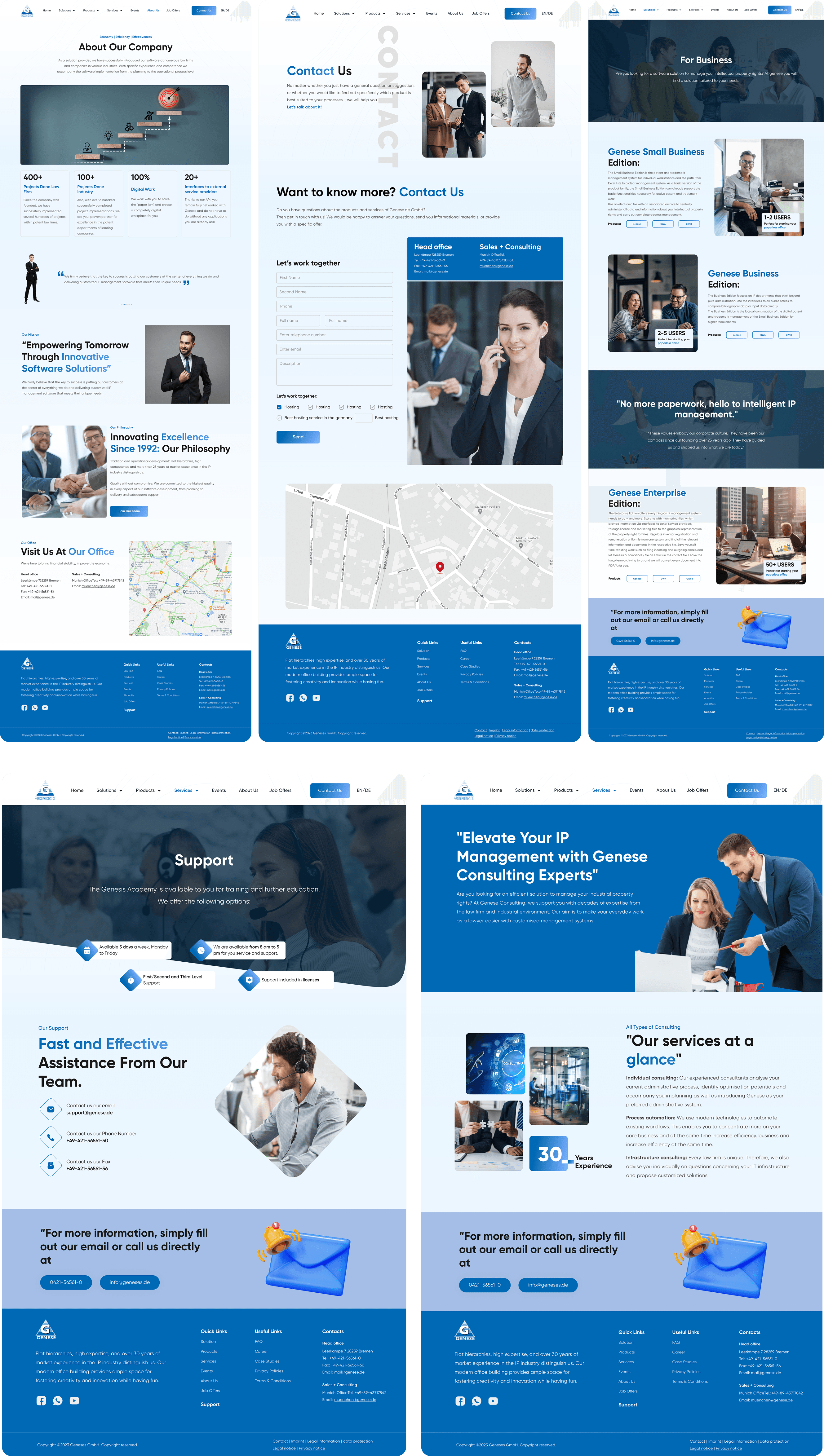
A fully redesigned website for Genese GmbH covering the complete company presence — homepage, solutions and products overview, services, events, about, and contact built on a dual-typeface system (Gilroy + Manrope), a blue gradient palette (#10069B5 to #A5BEE7) on deep black (#040404), and a layout logic that led with client benefit and service clarity rather than company history.
Key design decisions
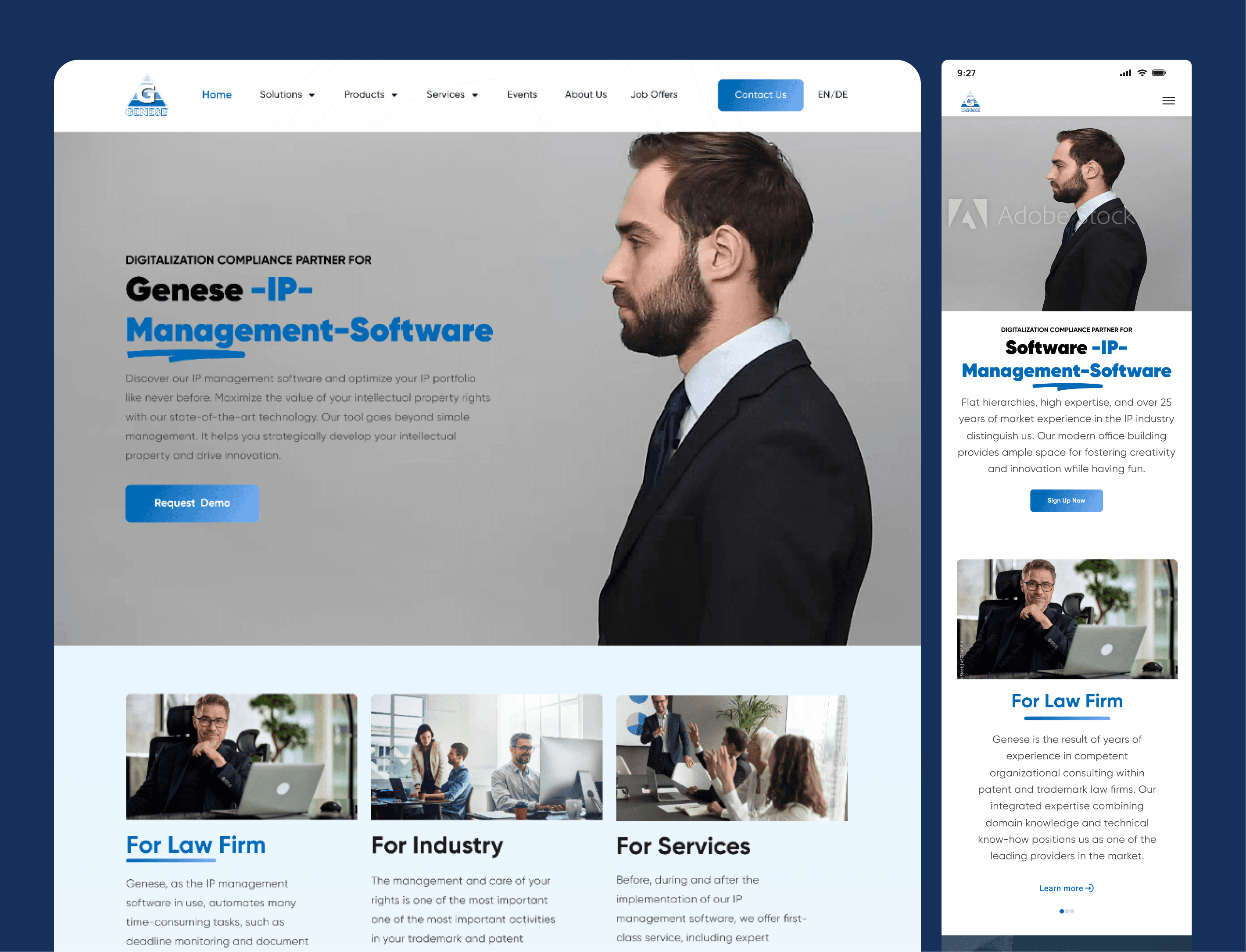
1. People-first homepage hierarchy. The hero section leads with what Genese does for law firms and patent attorneys, not how long they've been doing it. The 25-year credibility signal is present it's surfaced in the company philosophy section but it supports the value claim rather than replacing it. That sequencing change alone made the homepage feel like a different company. 2. Gilroy and Manrope as a credibility pair. Gilroy at display size communicates confidence without arrogance it's the right register for a company that's been the leading provider in a specialist market for decades. Manrope in body copy brings it back to human scale. The pairing was deliberate: authority in the headline, approachability in the detail. That tone matches exactly what Genese wanted to project. 3. "Everything you need for modern digital IP management" as the structural anchor. The product and module section was redesigned around a single, scannable promise rather than a feature list. Prospects evaluating IP management software don't want to read a capabilities matrix on a homepage they want to know if this company understands their world. Leading with the outcome, then detailing the modules beneath it, gives both audiences what they need.
Results & Impact
Quantitative results
Full website redesign delivered across desktop and mobile. Complete visual identity system established typeface pairing, color system, gradient treatment, and logo refinement. Design process completed across a four-stage sprint: UX (24%), UI (55%), Prototyping (11%), Testing (10%).
Qualitative outcomes
The redesign resolved the core positioning gap identified in the brief the new website reads as a modern, forward-looking IP management partner rather than a company coasting on historical credibility. The human-first narrative structure gives Genese a homepage that speaks directly to the law firm and patent office decision-makers they're targeting, rather than to a general audience. The visual identity update modernised the brand without abandoning the color territory Genese's existing clients already associate with them.
Business impact
Genese now has a web presence that can compete in the global IP management software market not just the German one. The new products and technologies they'd developed had no credible showcase before this redesign. Now they do. For a company whose client relationships typically start with a website visit from a law firm evaluating multiple providers, the gap between the old site and the new one is a genuine commercial difference.
Next Steps
What's next (and why)
The case studies section linked in the footer but not yet built out is the highest-value content investment available to Genese post-launch. A software company with 25 years of successful implementations across law firms and patent offices has an enormous bank of real-world proof to draw on. Publishing three to five detailed case studies would give the website the social proof layer it currently relies on the company philosophy section to carry.
Open questions / hypotheses
Does the new human-first positioning actually land differently with the law firm audience than the previous history-led approach or is that audience primarily evaluating on feature depth and integration capability regardless of how the website is framed? Post-launch analytics on time-on-page for the solutions and products section would start to answer that within the first quarter.
Learnings
Genese reinforced something I think about on every legacy brand project the instinct to protect history usually comes from the right place, but it can trap a company in a story that no longer serves them. The job wasn't to erase 25 years of credibility. It was to stop letting those 25 years do all the talking. A company that's been leading in a specialist market for that long has earned the right to lead with what they can do now, not just what they've done before. That's what the redesign gave them.