Helping Crequity.ai Turn Six Disconnected Financial Roles Into One Unified Mobile Platform
Role
Duration
Team
Platform
Key Metric 1
Faster cross-role transaction time
Key Metric 2
Average satisfaction from pilot users
Key Metric 3
User satisfaction score
Summary
Overview
Crequity.ai needed one mobile platform that could serve six completely different user types — Borrowers, Lenders, Investors, Lawyers, Brokers, and Title Companies — without any of them feeling like an afterthought. I designed all six apps from scratch, built on a shared information architecture and a centralized design system. The result cut cross-role transaction time by 40% and earned a 4.8/5 satisfaction score from pilot users.
Six roles, six distinct journeys, one connected financial ecosystem — built from the ground up.
Problem Framing
The Core Problem
Financial workflows in lending and real estate are deeply siloed. Borrowers chase paperwork through email threads. Lenders manually juggle application stacks. Lawyers drown in compliance docs with no clear handoff system. Every role was doing the same transaction — just from a different, disconnected corner. Crequity wanted to collapse all of that into one platform.
Why it mattered
The cost wasn't just inefficiency — it was trust. Each delay and miscommunication in a lending deal erodes confidence between parties. Crequity's business model depends on transaction speed and relationship continuity. A platform that frustrates any one of the six roles breaks the whole chain.
Supporting data / evidence
Discovery interviews with real users across all six roles revealed consistent pain: Borrowers described the process as "confusing and stressful," Lenders said approvals took "days when they should take hours," and Lawyers flagged missing paper trails as a compliance risk. These weren't edge cases — every role had a core workflow that was either manual, fragmented, or both.
Role & Team
My Role
I was the sole designer on this project, responsible for the full scope — user research, information architecture, wireframes, the design system, and all six final UI deliverables. I owned every design decision from discovery to handoff. Engineering and QA were handled by Crequity's internal team.
Team Composition
Solo designer (me). Crequity.ai provided stakeholder access and facilitated user interviews across all six role types.
Stakeholders & decision-makers
Crequity.ai's product and business leadership. Design reviews were conducted directly with the client throughout the process, with pilot users from each role group validating the final flows.
Approach
Strategy & framework
The core challenge was designing six different apps without creating six different products. My strategy was to define a shared foundation first — one information architecture, one design system, one component library — then build role-specific experiences on top of it. Every app had to feel personal to its user but recognizably part of the same ecosystem.
Research methods used
Direct interviews with users from all six role groups. Behavior and frustration mapping per role. Jobs-to-be-done framing to isolate what each role actually needed to get done (not just what they said they wanted). Competitive audit of existing fintech platforms.
Key insight(s)
Every role had a different emotional relationship with the process. Borrowers needed reassurance. Lenders needed speed. Investors needed visibility. Lawyers needed trust. Brokers needed coordination. Title companies needed precision. The design system had to be neutral enough to carry all six tones — which meant no role could feel like an add-on to someone else's primary product.
Challenges
Primary challenge
Designing six apps in parallel without them drifting apart. Early wireframes for each role started diverging quickly — different patterns, different component assumptions, different interaction styles. If left unchecked, the "unified ecosystem" would have been six separate products with matching colors.
How I navigated it
I paused feature work early and built the design system first. Shared core modules — authentication, notifications, in-app chat — were locked before any role-specific flows were designed. This forced consistency at the component level, which meant the apps could diverge visually only within defined limits. It added time upfront but saved significant rework later.
What I Did differently
I'd run a cross-role workshop earlier in the process — getting a Borrower and a Lender to walk through the same transaction from their own screens reveals handoff gaps that interviews alone don't surface. I caught a few of those gaps late in the process during prototype reviews.
Solution
What I designed
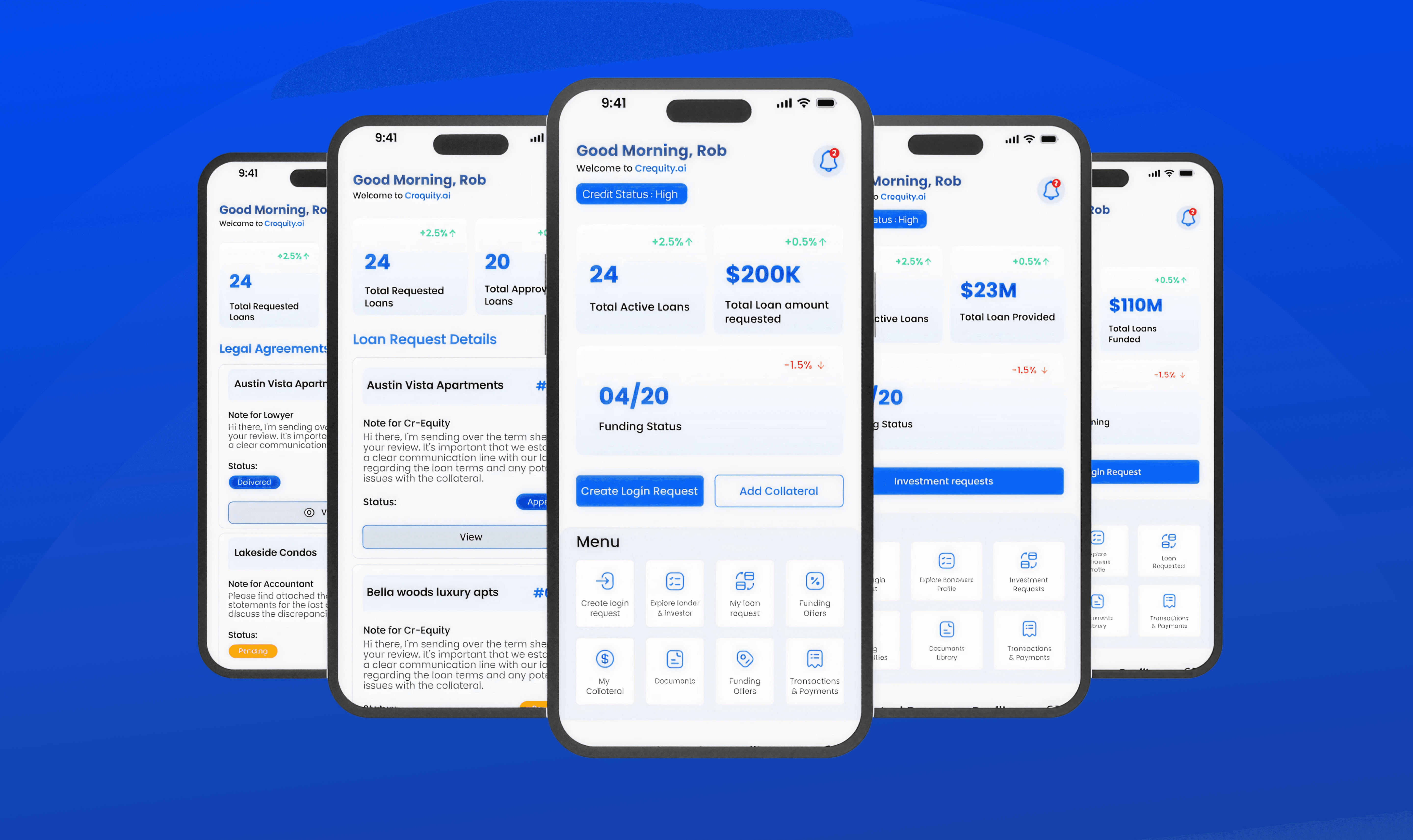
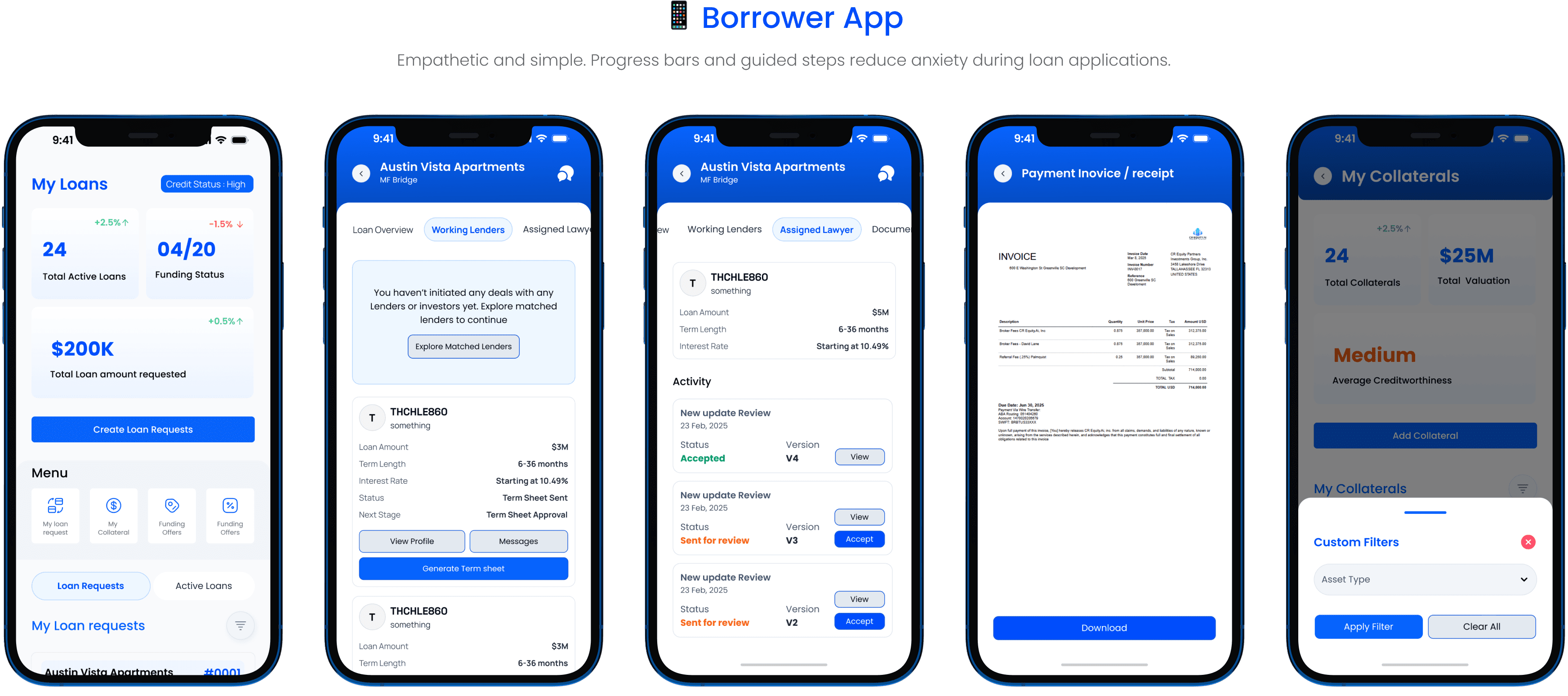
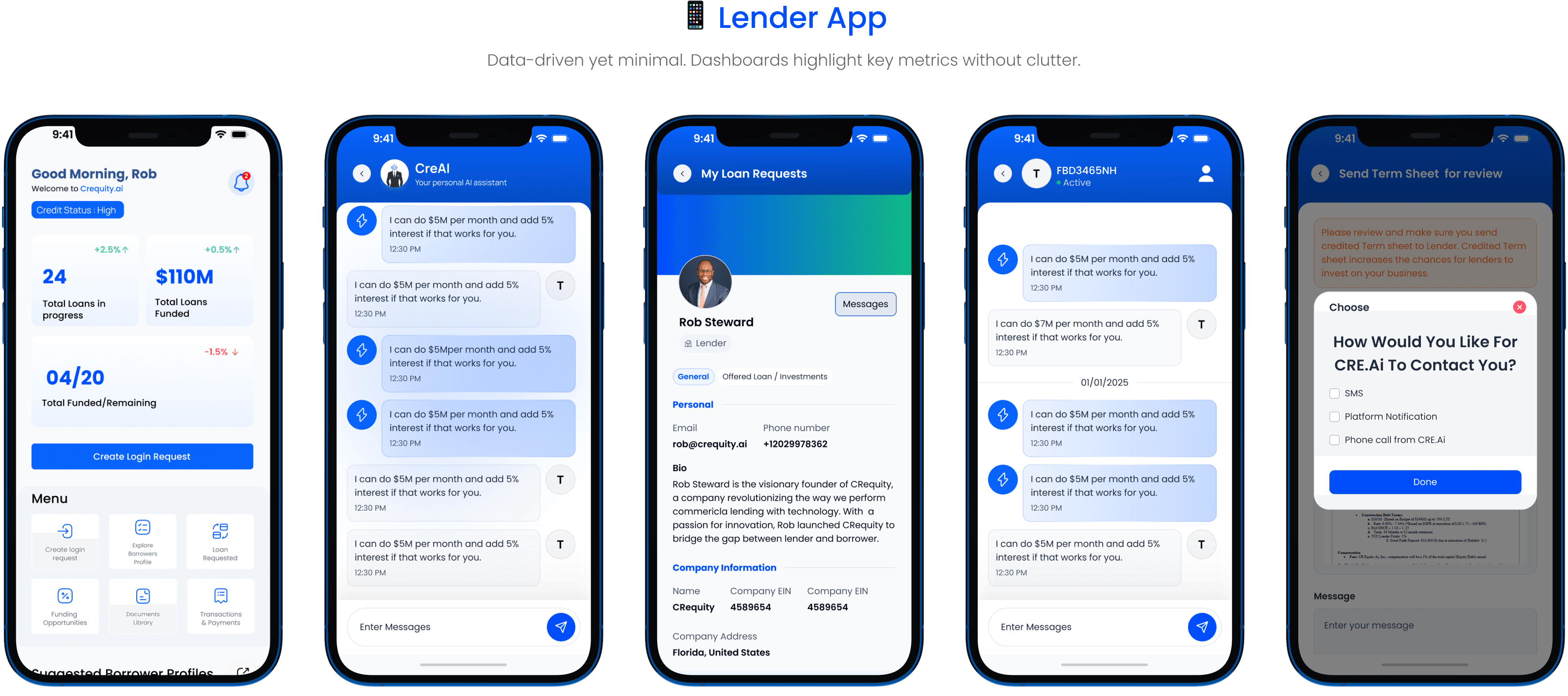
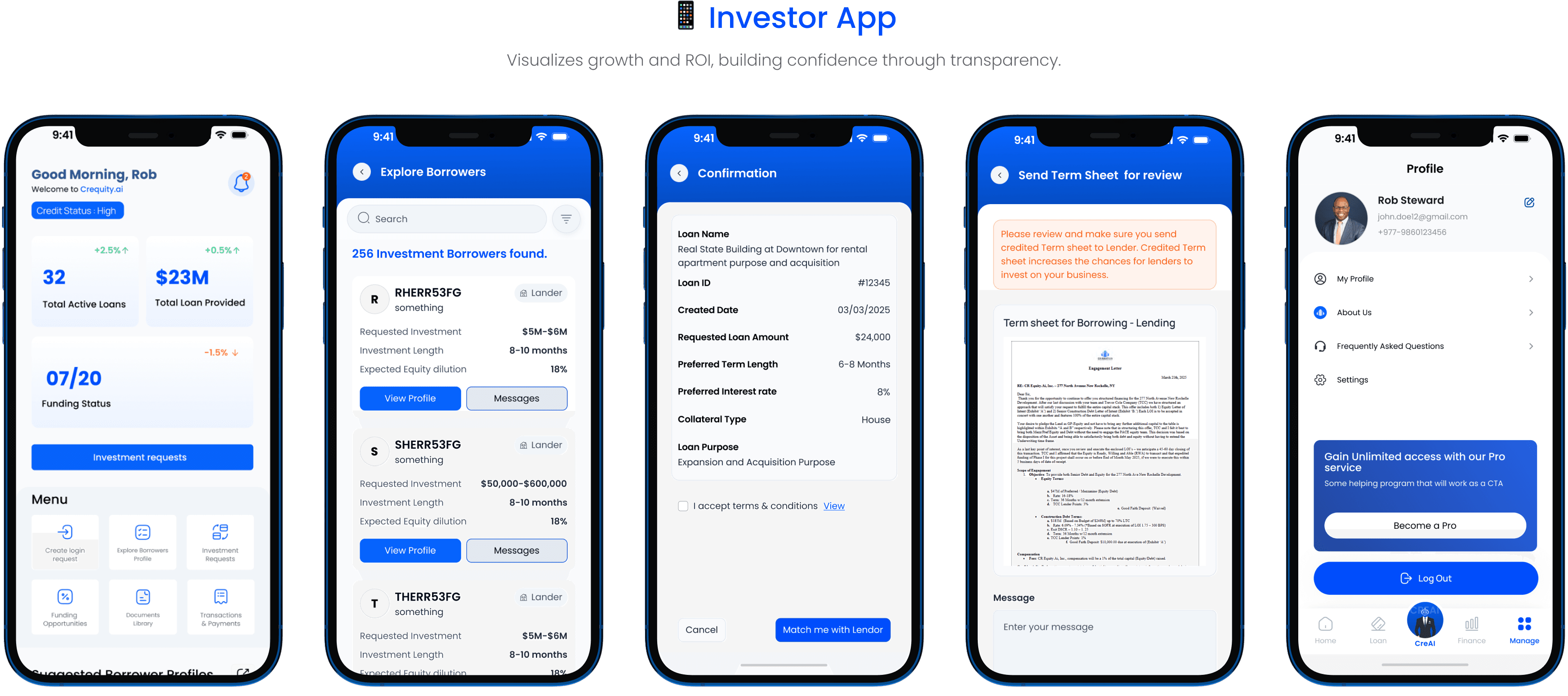
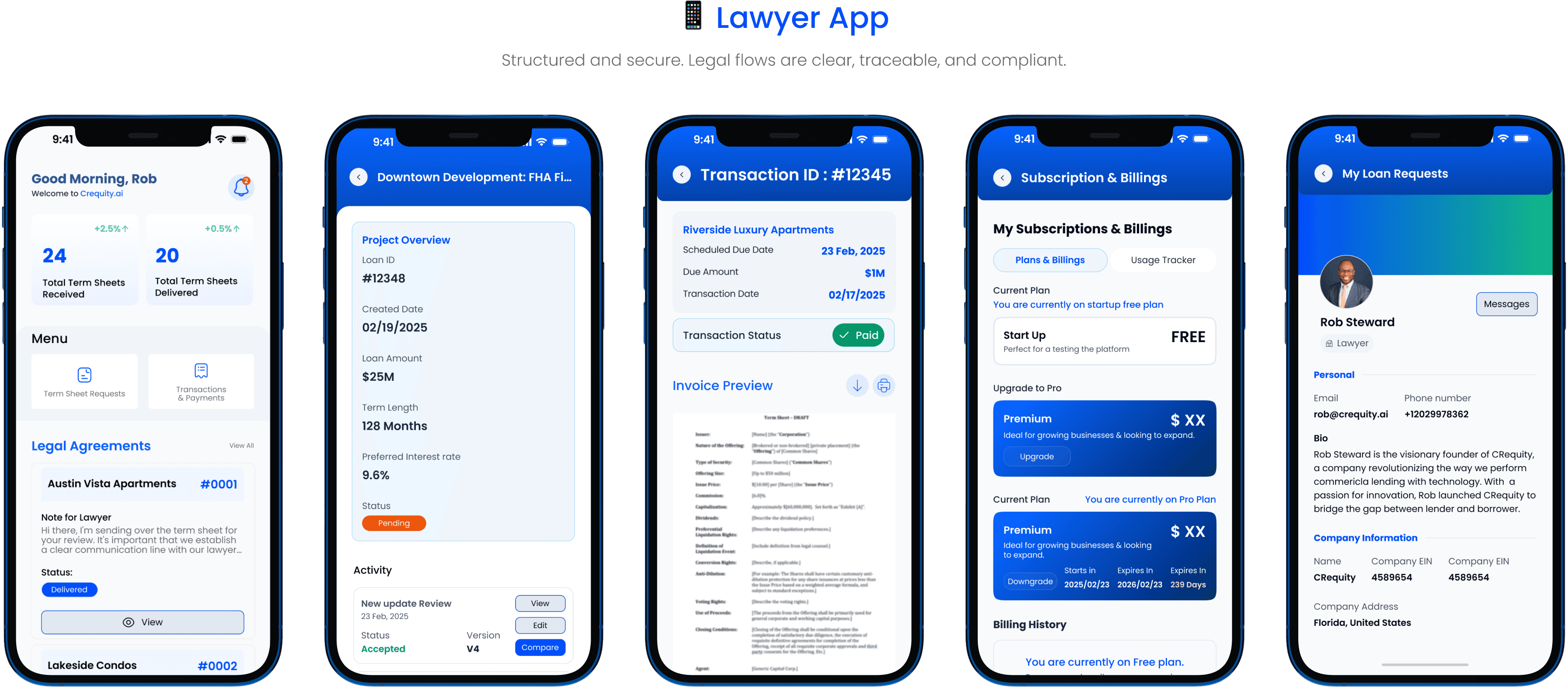
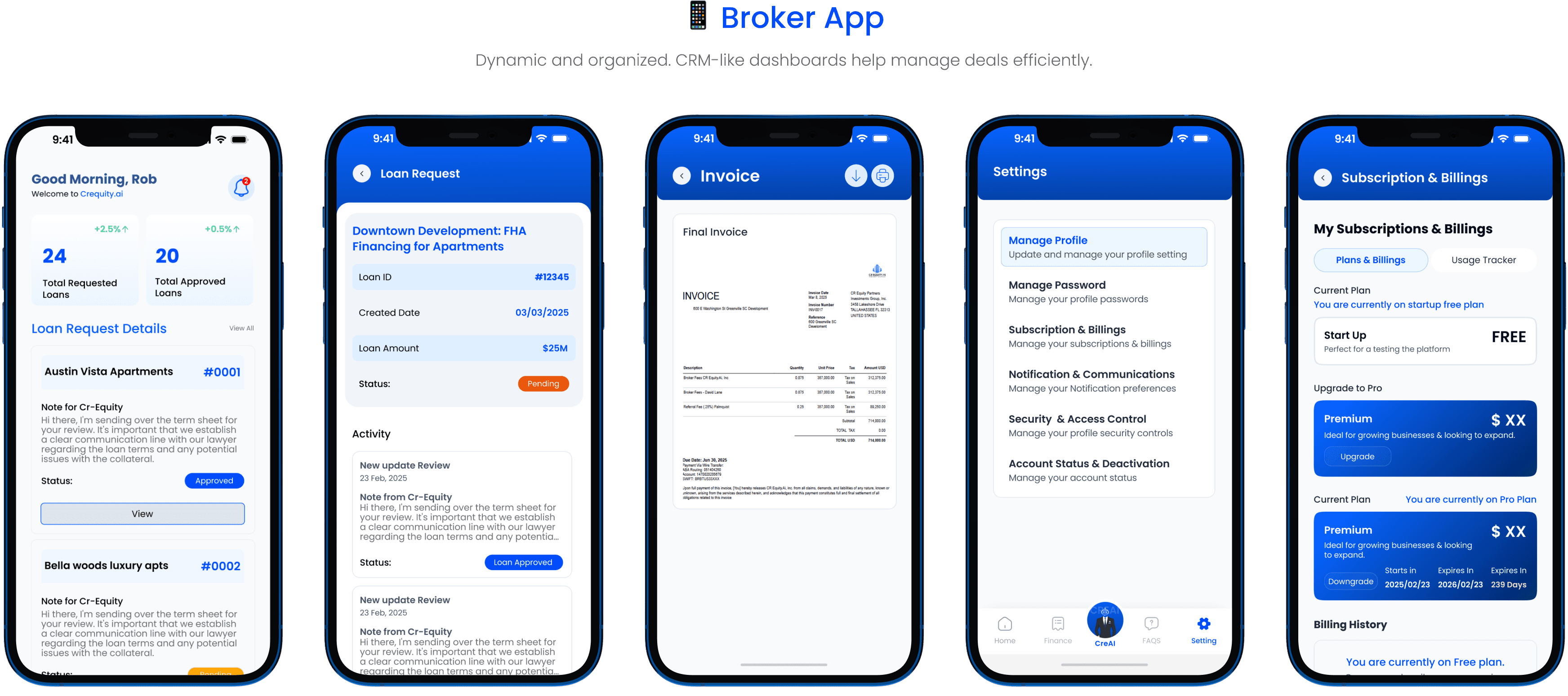
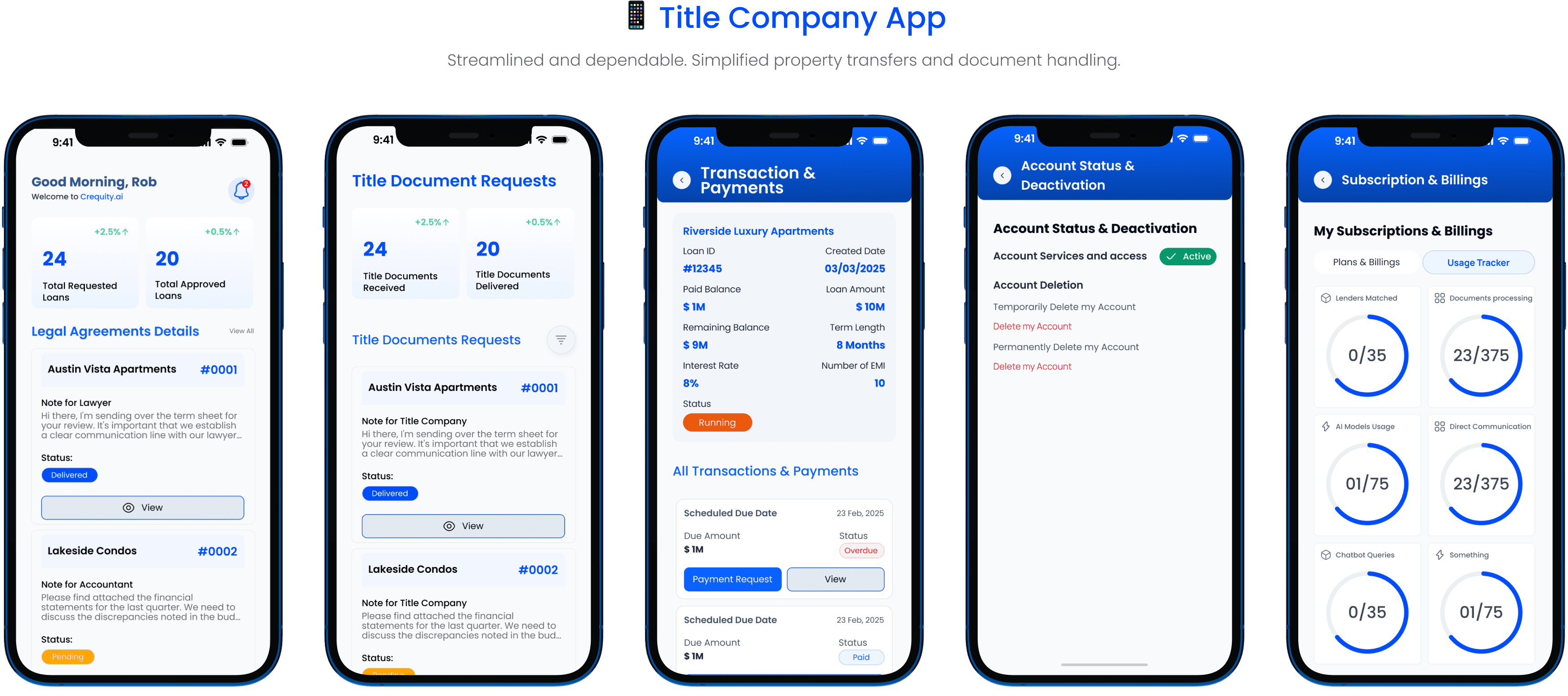
Six mobile apps — Borrower, Lender, Investor, Lawyer, Broker, and Title Company — each with a distinct visual rhythm and feature set, all running on the same underlying design system and shared architecture. Core modules (auth, chat, notifications) are consistent across all six. Role-specific modules handle the divergent workflows.
Key design decisions
1. Shared IA before role-specific flows. I mapped a unified information architecture covering all six roles before designing a single screen. This gave every app the same navigational skeleton, making the ecosystem feel coherent even when the UIs looked different. 2. One design system, six tones. The system used Poppins across all apps with a primary blue palette (HEX #004DFB) anchoring Crequity's brand. Component variants were built to flex — the same card component reads as "data-dense dashboard" for Lenders and "step-by-step guidance" for Borrowers, depending on how it's populated. 3. Emotional design by role. Borrower flows prioritized progress bars and calm, linear guidance to reduce anxiety. Lender dashboards were built for scan-speed with key metrics surfaced immediately. Lawyer flows were structured around document traceability and compliance checkpoints. Each role got what they actually needed — not what looked impressive in a demo.
Results & Impact
Quantitative results
40% reduction in cross-role transaction time after platform launch. 4.8/5 average satisfaction score from pilot users across all six role groups.
Qualitative outcomes
Pilot feedback highlighted improved coordination specifically between Borrowers, Lenders, and Lawyers — the three roles most involved in active loan transactions. Users described the platform as "finally feeling like one system" rather than separate tools. The shared notification and chat layer was called out specifically as reducing back-and-forth email chains.
Business impact
Crequity moved from a conceptual multi-role platform to a working product with validated user satisfaction. The 40% transaction time reduction directly supports their core value proposition — faster, collaborative lending. The pilot results gave Crequity a credible data story for investor and client conversations.
Next Steps
What's next (and why)
The six apps are built and validated, but the real opportunity is in the handoff moments between roles — the points where a Borrower's submission lands in a Lender's queue, or where a Lawyer needs to pull a document a Broker uploaded. Designing smarter, proactive notifications and cross-role status visibility would reduce the coordination overhead that still requires users to leave the app.
Open questions / hypotheses
Does a unified dashboard view — where, say, a Broker can see the status of all parties in a deal simultaneously — reduce deal time further? And how does onboarding work for new users who join the platform mid-deal, without the context of the full flow?
Learnings
The biggest takeaway: emotional design and system design are not separate disciplines on a project like this. You cannot build a good Borrower experience on top of a design system built only for Lenders. The architecture has to be empathy-first from day one — or the role-specific work has nowhere solid to stand.