Pronexa Consultancy a trust-first web presence redesigning navigation, CTAs, and credibility signals from scratch
Role
Duration
Team
Platform
Key Metric 1
Core UX problems identified and solved
Key Metric 2
Grid system built for consistent, scalable layouts
Key Metric 3
Fully responsive across all screen sizes
Summary
Overview
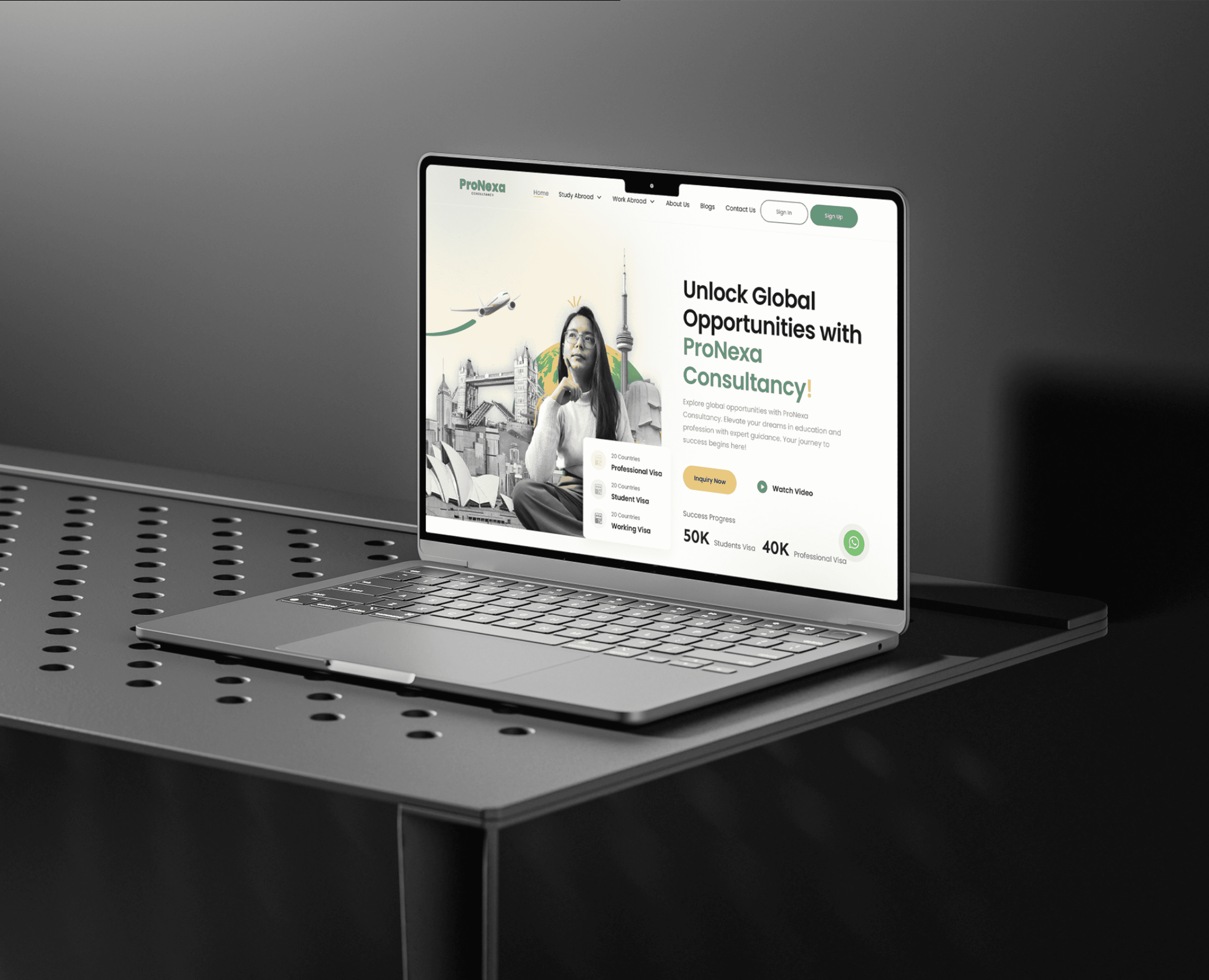
Pronexa Consultancy had a website that looked like a consultancy but didn't feel like one. Unclear navigation, weak CTAs, no real trust signals, and mobile usability issues were quietly killing the inquiry rate. I redesigned the full site from information architecture through final high-fidelity UI, structuring the service offering clearly, introducing credibility layers, and building a consistent design system that made the brand feel as professional as the actual service.
Pronexa's services were solid. The website just wasn't making the case for them.
Problem Framing
The Core Problem
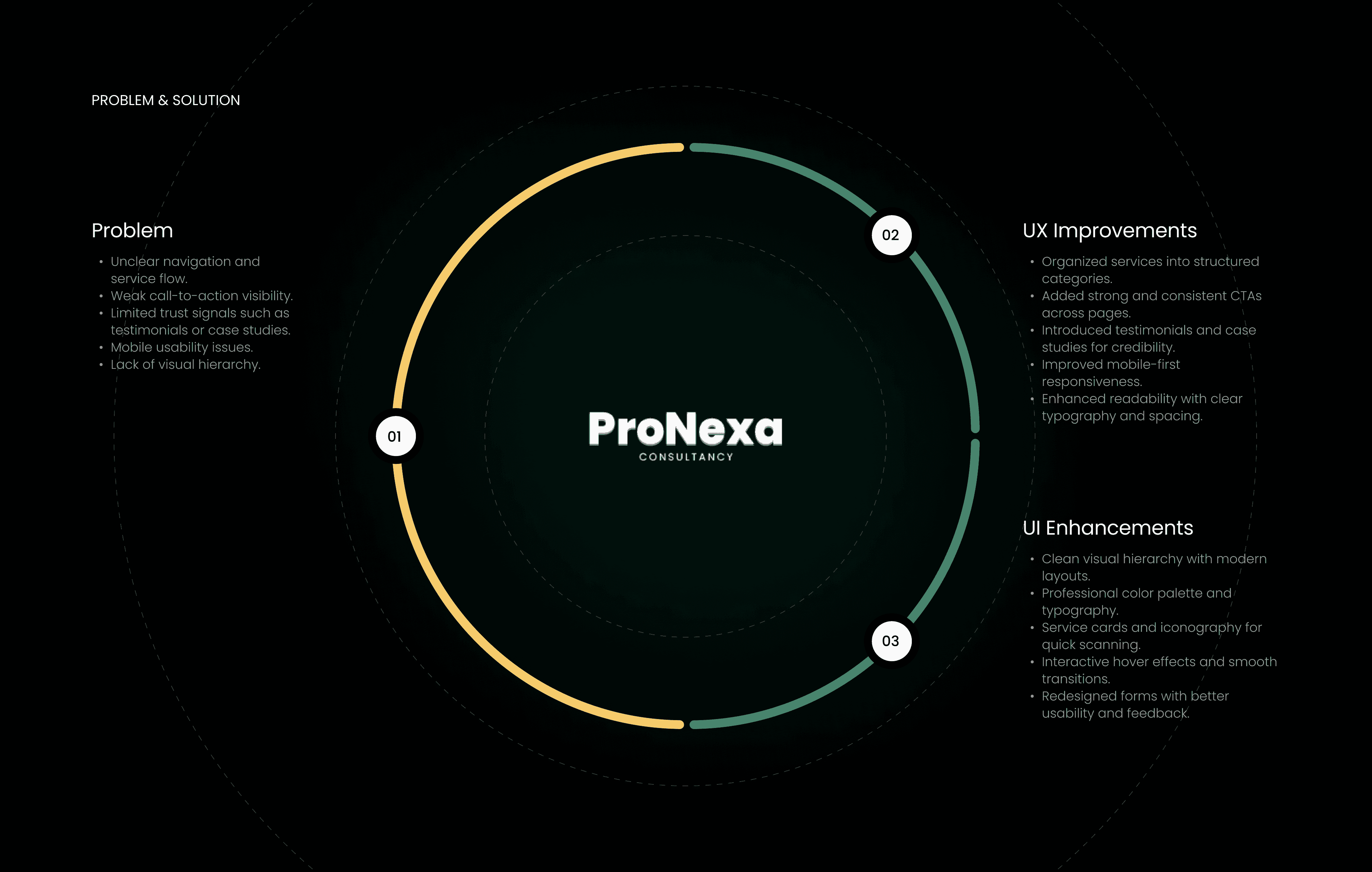
Five problems stacked on top of each other, unclear navigation, invisible CTAs, no trust signals, poor mobile usability, and a flat visual hierarchy that made every section feel equally unimportant. Any one of those would hurt conversion. All five together meant the site was actively working against the business.
Why it mattered
For a consultancy, the website is the pitch. Clients making a decision about who to trust with their business problems are forming that judgment in the first thirty seconds on the page. A site that feels disorganised or unprofessional doesn't get a second chance, the visitor just leaves and calls someone else.
Supporting data / evidence
Stakeholder feedback and design audit identified the five core failure points directly. Navigation structure had no logical grouping, services, about, and contact were all at the same visual weight. CTAs were inconsistent across pages, sometimes absent entirely. Testimonials and case studies, the two highest-trust elements on any consultancy site, were missing. Mobile layouts broke the reading flow on key service pages.
Role & Team
My Role
I handled the full scope, site map and information architecture, early paper sketches, low-fidelity wireframes, visual design system, UI design across all pages, responsive layout adjustments, and usability iteration based on stakeholder feedback. Every design decision from structure to typography was mine to define and deliver.
Team Composition
Solo designer. Pronexa's team provided brand direction, service content, and stakeholder feedback at wireframe and high-fidelity review stages.
Stakeholders & decision-makers
Pronexa Consultancy's leadership. Design iterations were driven by stakeholder feedback rounds, particularly around CTA placement, service page structure, and the credibility sections.
Approach
Strategy & framework
The project scope covered five distinct workstreams, Information Architecture, Wireframes and Prototyping, Visual and UI Design, Responsive Design, and Usability Testing, and I treated each as a dependency, not a parallel track. IA came first because every layout decision downstream depended on having a clear site map. Wireframes followed before any visual work started. That sequencing prevented the common revamp failure where visual design gets locked in before the structure is actually solved.
Research methods used
Design audit of the existing site against navigation, hierarchy, and conversion best practices. Stakeholder interviews to understand service priorities and target audience expectations. Competitive review of comparable consultancy websites. Low-fidelity wireframe testing to validate layout and user journey before high-fidelity investment. Iterative usability testing with stakeholder feedback throughout.
Key insight(s)
The missing trust signals were the biggest conversion gap, not the navigation, not the CTAs. A consultancy site without testimonials or case studies is asking visitors to make a trust decision with no evidence. Once I introduced those elements at strategic points in the user journey, the CTA placement problem partially solved itself, users who'd read a testimonial were already closer to inquiry before they hit a CTA.
Challenges
Primary challenge
Simplifying a complex service offering into clear, scannable sections without flattening the nuance that makes Pronexa's work actually differentiated. Consultancy services resist simple categorisation, they're often context-dependent, overlapping, and difficult to describe in a card format without losing what makes them worth buying.
How I navigated it
I structured the information architecture around user intent rather than service taxonomy. Instead of listing what Pronexa offers, the site guides visitors through what they need, which naturally surfaces the right services at the right moment. Service cards and iconography handled the scanning layer, while individual service pages carried the depth for users who wanted it.
What I Did differently
I'd push for real user testing, not just stakeholder feedback, specifically on the service pages. Stakeholders know the services deeply, which makes them poor proxies for a first-time visitor trying to figure out if Pronexa is the right fit. An outside perspective on those pages early would have sharpened the copy hierarchy before the final UI was built.
Solution
What I designed
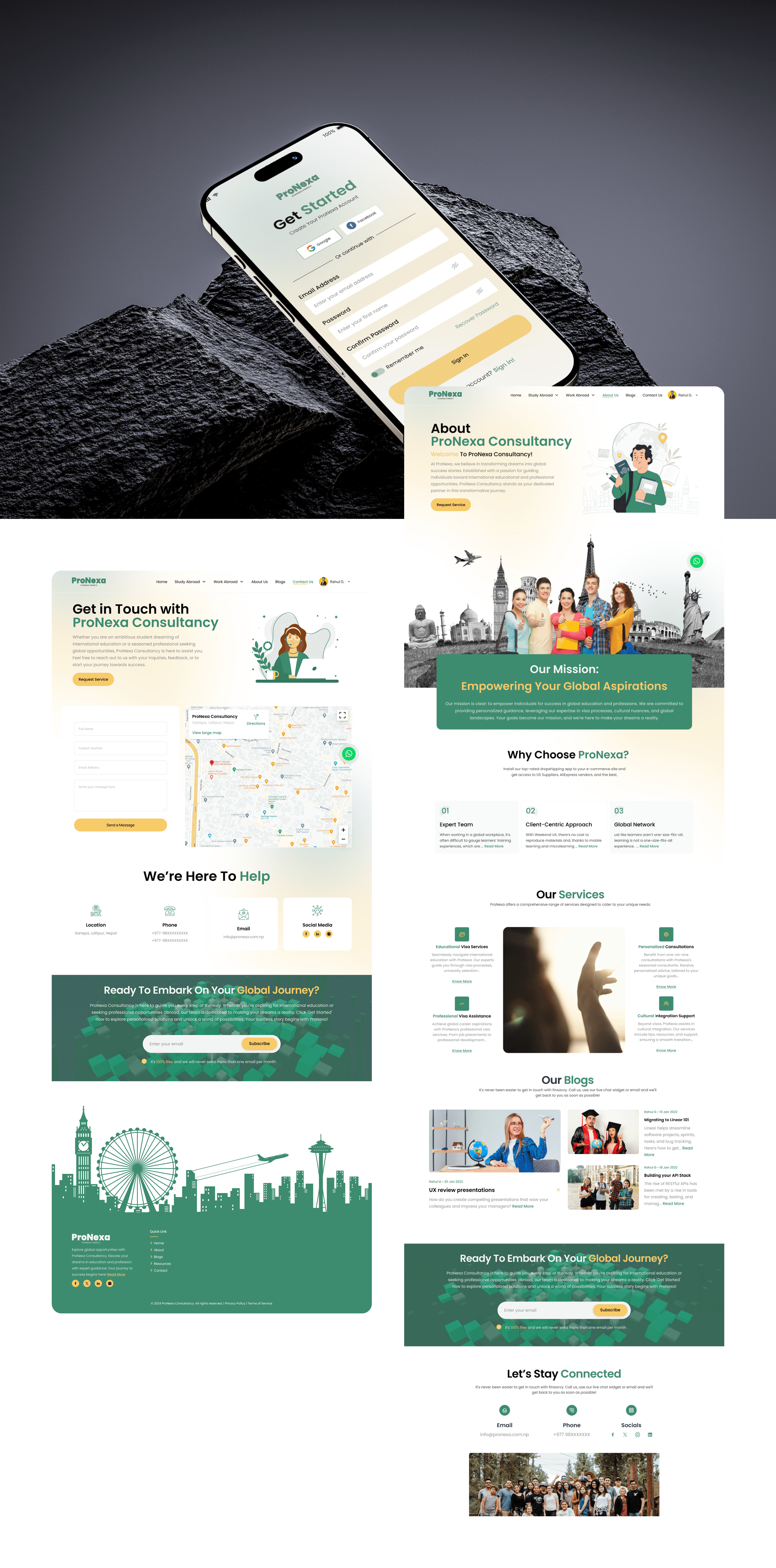
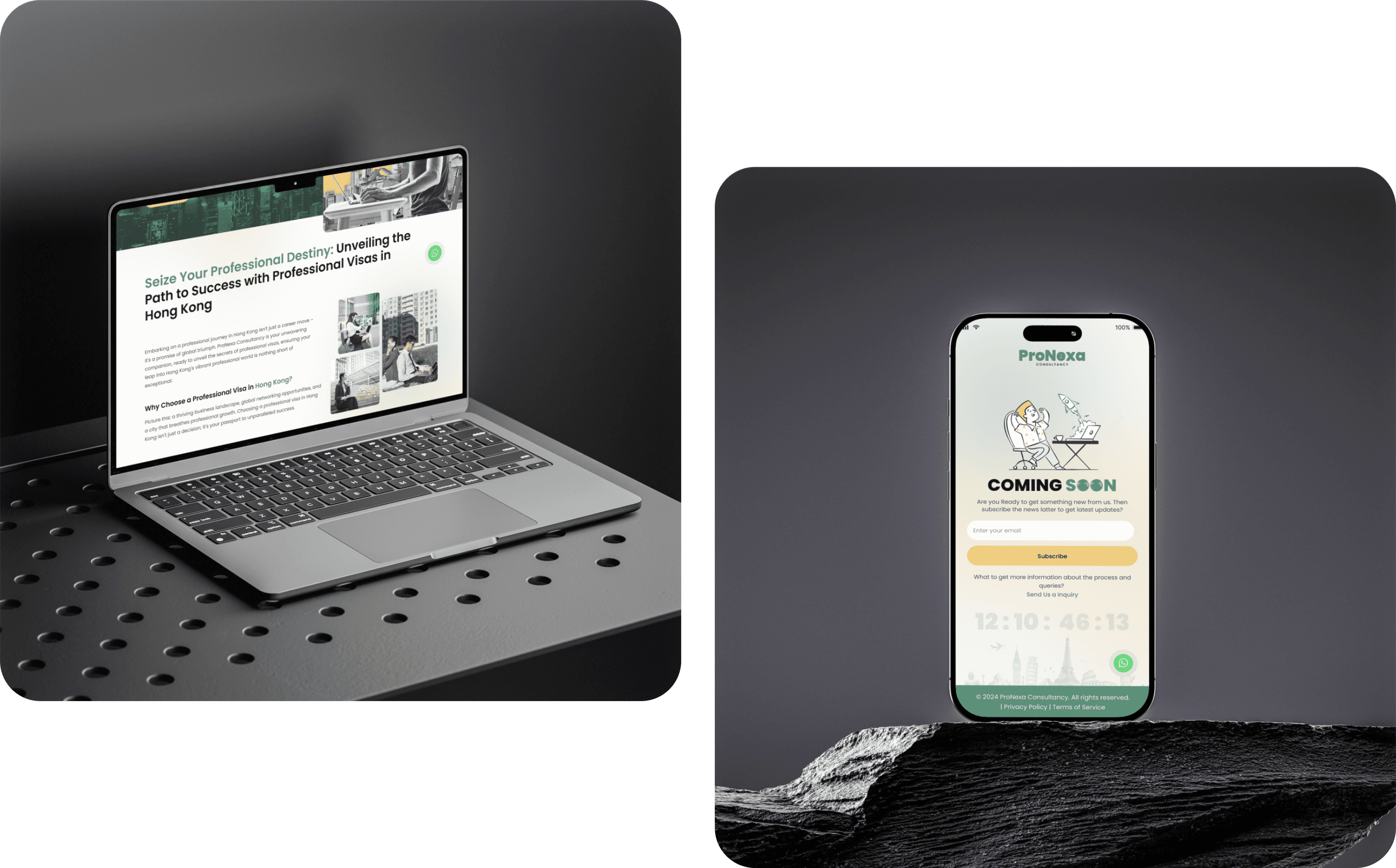
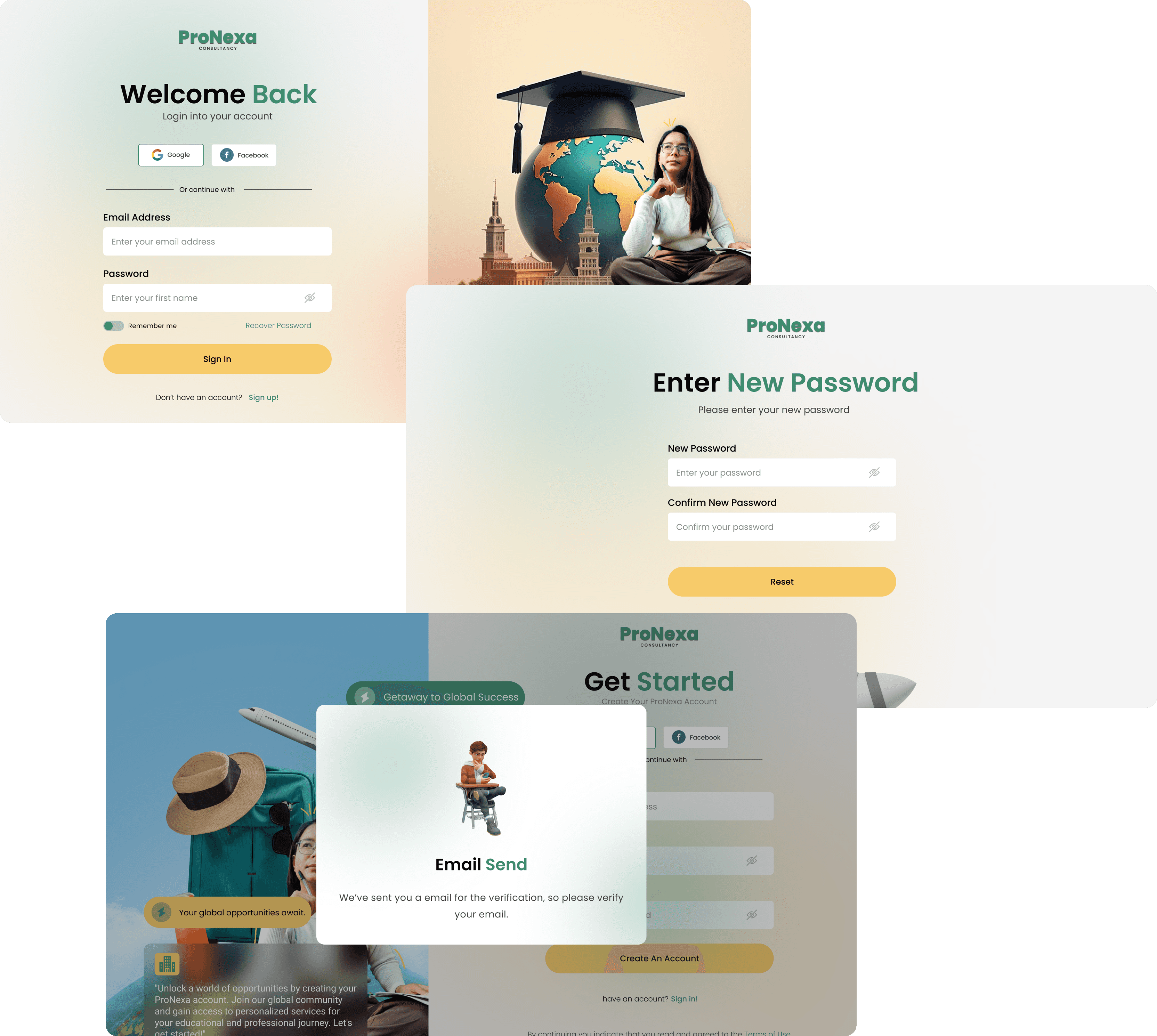
A fully responsive consultancy website covering Home, Services, About, Contact, and Case Studies, structured on a 12-column grid (64px column / 32px gutter), built with Poppins as the primary typeface, and using a green, yellow, black, and white palette that reads as professional without defaulting to the corporate-blue template most consultancy sites lean on.
Key design decisions
1. Testimonials and case studies as structural elements, not afterthoughts. Trust signals were designed into the page hierarchy — not added to a footer or a dedicated page most visitors never reach. A testimonial near the primary service CTA and a case study preview on the homepage were the two highest-impact additions to the existing content structure. 2. Consistent CTAs across every page. The previous site had CTAs that appeared, disappeared, and changed wording without logic. I defined a single primary CTA — inquiry-focused, consistent in copy and placement — and applied it across every page. Removing the inconsistency removed the decision friction for visitors who were ready to act. 3. Service cards with iconography for scan-speed. The services section was redesigned around a card-and-icon pattern that lets visitors understand the offering in two seconds without reading a paragraph. Full detail lives one click deeper, which keeps the homepage clean while still serving users who want specifics.

Results & Impact
Quantitative results
Five core UX problems resolved across navigation, CTA visibility, trust signals, mobile usability, and visual hierarchy. Full responsive build across desktop and mobile. 12-column grid system established for consistent scaling. Usability iterations completed based on stakeholder feedback rounds.
Qualitative outcomes
Stakeholder feedback after the usability testing rounds highlighted the service clarity improvement as the most noticeable change, services that previously required explanation now read clearly at a glance. The trust signal additions, testimonials and case studies, were described as "filling a gap we didn't know was hurting us." Mobile usability issues that were generating direct complaints were fully resolved in the responsive build.
Business impact
Pronexa now has a website that does the first job of a consultancy site, makes the right visitor feel confident enough to get in touch. The consistent CTA structure creates a clear conversion path from every page. The credibility layer gives new visitors the social proof they need to act. And the mobile-first build ensures none of that is lost on the device most visitors are actually using.
Next Steps
What's next (and why)
The Case Studies section is the highest-leverage content investment available to Pronexa right now. The section exists in the structure, but it needs real case content to do its job. Each published case study compounds the site's trust signal over time and improves search visibility for service-specific queries. I'd prioritise getting two or three strong case studies live before anything else.
Open questions / hypotheses
Does the current service card structure actually help visitors self-select the right service, or does it create a different kind of confusion by presenting options without enough context to differentiate them? That question is worth a short user testing session on the live site within the first month of launch.
Learnings
This project reinforced something that's easy to underestimate on consultancy work specifically, credibility design is a discipline of its own. It's not just about looking professional. It's about knowing which trust signals matter to which visitors, where in the journey they need to appear, and how to present them without looking like you're trying too hard. Getting that sequencing right is what separates a site that converts from one that just looks good.