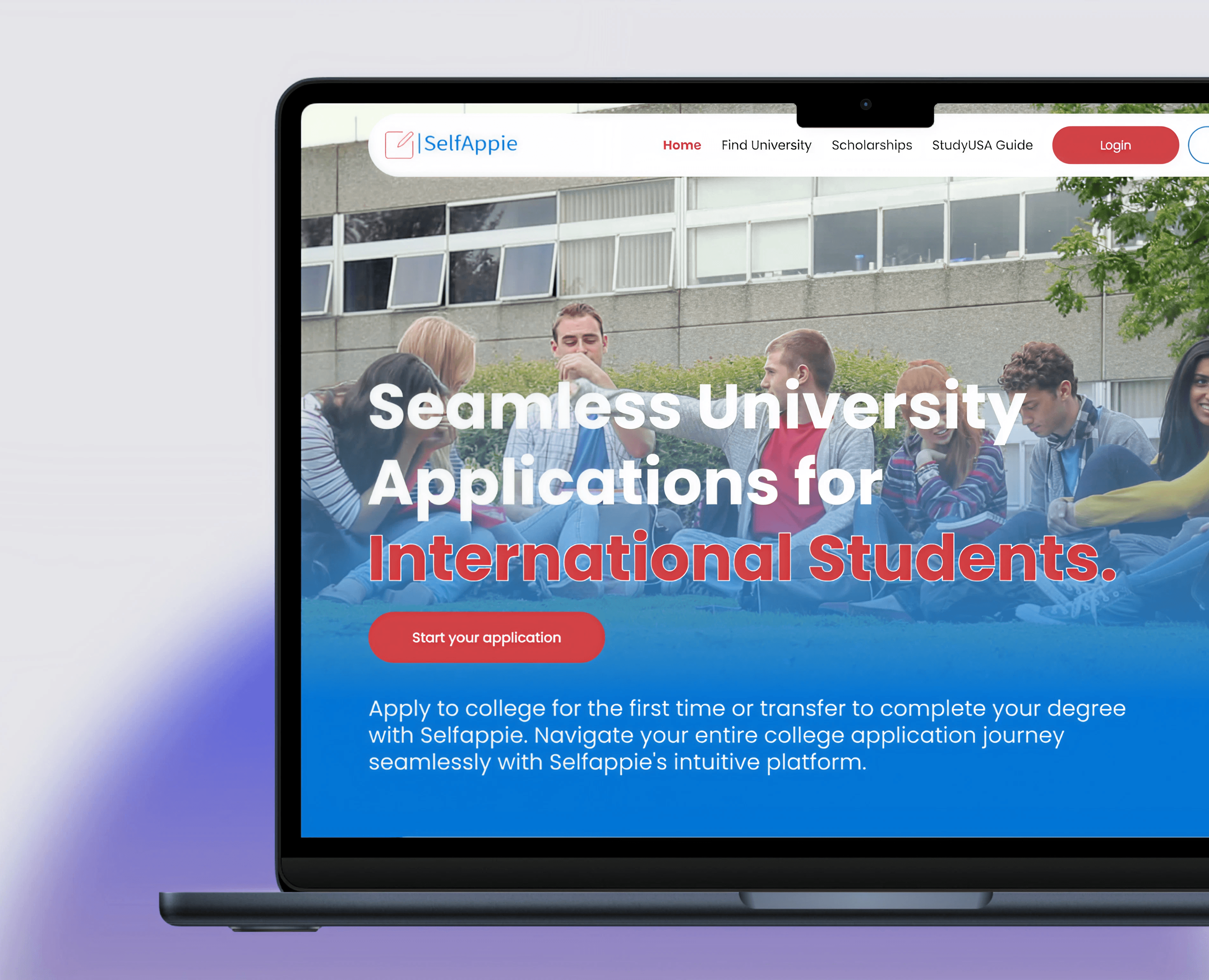
SelfAppie confident university applications for international students designing a guided web app that turns self-assessment into a clear action plan
Role
Duration
Team
Platform
Key Metric 1
User journey mapped from awareness to future action
Key Metric 2
Financial simulation flow — from confusion to a debt-free path
Key Metric 3
University search, scholarships, applications, and tracking unified
Summary
Overview
International students applying to universities face a problem that's equal parts practical and emotional, too many platforms, too little personalised guidance, and no clear sense of what to do next. SelfAppie was built to fix that. I designed the full web app experience from landing page through application dashboard, covering self-assessment flows, university and scholarship discovery, a financial simulation layer, and a complete application tracking system. The platform guides a student from "I don't know where to start" to a submitted application, in one place, without needing outside help to understand the process.
Every international student knows what they want. SelfAppie was designed to show them how to get there.
Problem Framing
The Core Problem
Students trying to plan their academic future were drowning in disconnected tools, one site for university search, another for scholarships, another for cost estimates, another for applications. None of them talked to each other. None of them accounted for who the student actually was. The result was decision paralysis dressed up as research.
Why it mattered
For international students specifically, the stakes are unusually high, wrong program, wrong financial plan, or a missed deadline can mean an entire year lost. The cost of a confusing platform isn't frustration, it's real damage to real futures. SelfAppie needed to be the platform that made the process feel manageable, not just possible.
Supporting data / evidence
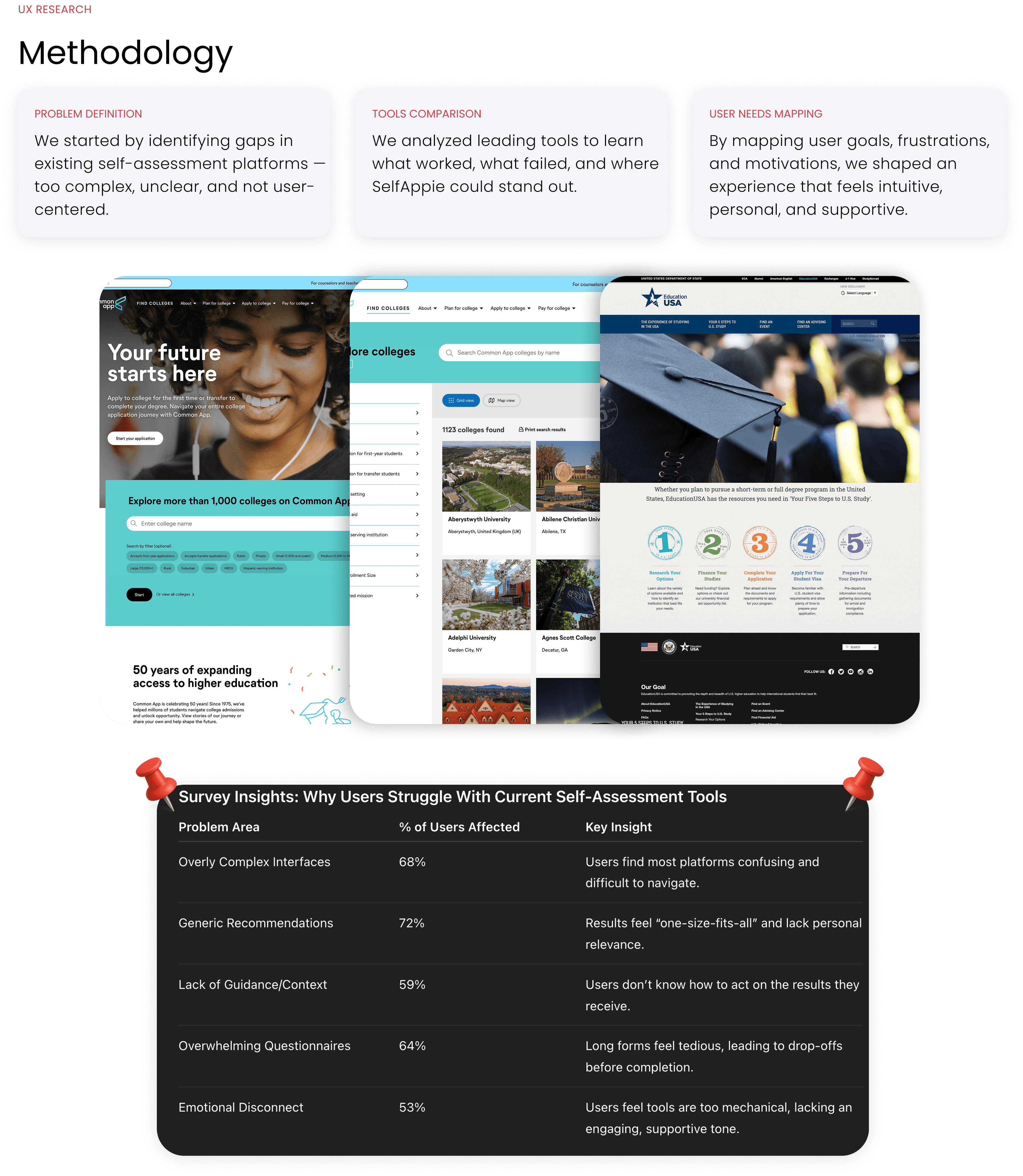
UX research identified three consistent failure points in existing self-assessment and university planning tools, platforms were too complex, not user-centred, and actively confusing rather than guiding. User persona research surfaced a representative student profile: Rohan Sharma, a BBA undergraduate from Kathmandu, Nepal, whose needs, centralised resources, personalised recommendations, career-focused guidance, and a flexible interface, were shared across the target user base. The financial simulation flow was validated against real financial aid tools, with user testing showing that the FAID Calculator step produced the clearest shift from discouragement to relief in the entire journey.
Role & Team
My Role
I led the full design scope, UX research, problem definition, competitive tool analysis, user needs mapping, persona development, user journey mapping, simulation flow design, user flow architecture, and all final UI across the landing page, web app dashboard, program discovery, scholarship search, and application tracking sections.
Team Composition
Solo designer. SelfAppie's product team provided the platform vision, functional requirements, and domain expertise on the international student application process.
Stakeholders & decision-makers
SelfAppie's product and EdTech leadership. Key decisions around the simulation flow, application portal structure, and onboarding logic were reviewed directly with the client before moving to high-fidelity.
Approach
Strategy & framework
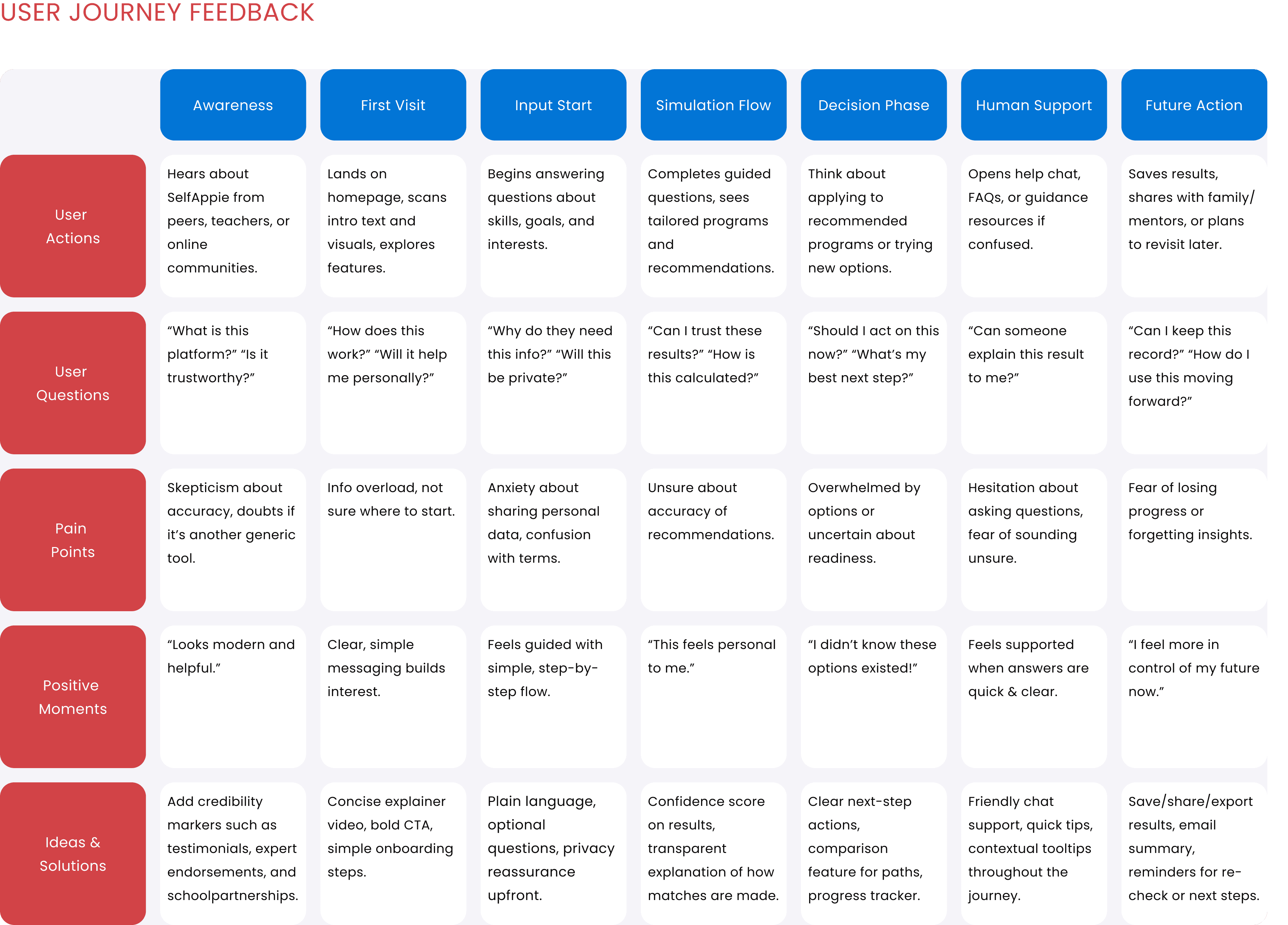
The design strategy treated the platform as a mentor, not a search engine. Search engines surface options. Mentors help you figure out which option is right for you. Every UX decision was made with that distinction in mind, the platform needed to feel like it understood the student's situation, not just their search query. The seven-stage user journey map, from first visit through future action, was the backbone of the entire design process. Every screen was built to answer the specific question a student is asking at that exact moment in the journey.
Research methods used
Gap analysis of existing self-assessment and university planning platforms. Competitive tool comparison to identify what worked, what failed, and where SelfAppie could differentiate. User needs mapping across goals, frustrations, and motivations. Persona development grounded in a real, representative student profile. Seven-stage user journey mapping covering questions, actions, pain points, positive moments, and design solutions at each stage. Financial simulation flow testing against real tools including UCSC Net Price Calculator and FAID Calculator.
Key insight(s)
The financial clarity moment is the emotional turning point of the entire journey. In user testing, the shift from the UCSC calculator, which left users feeling discouraged, to the FAID calculator, which showed a viable, debt-free path, was the single highest-impact moment in the simulation flow. Designing that transition deliberately, with the right framing and visual tone at each step, changed how students felt about the whole platform. Trust is built at the moment of unexpected good news, not during onboarding.
Challenges
Primary challenge
Designing a platform that handled genuinely complex application logic, multi-step forms, payment integration in two currencies, differentiated portals for undergraduate, graduate, and transfer students, while still feeling simple and low-anxiety to a first-time international student who may never have applied to a university abroad before.
How I navigated it
I separated the complexity into layers. The surface layer, what the student sees, was designed around progressive disclosure. Simple questions first, more detailed inputs later, optional fields clearly marked. The underlying complexity of the application system was handled in the flow architecture rather than the UI. A student filling in personal information doesn't need to see the Stripe payment integration logic — they need to know their next step is clear and their data is safe.
What I Did differently
The onboarding flow for first-time users needed more trust-building than the current design gives it. New users arriving from a peer recommendation or social channel have real scepticism about sharing personal and academic data with a platform they've never used. A more deliberate credibility sequence, what SelfAppie is, who built it, what happens to their data, and who has used it successfully, before the first input field would reduce that early drop-off.
Solution
What I designed
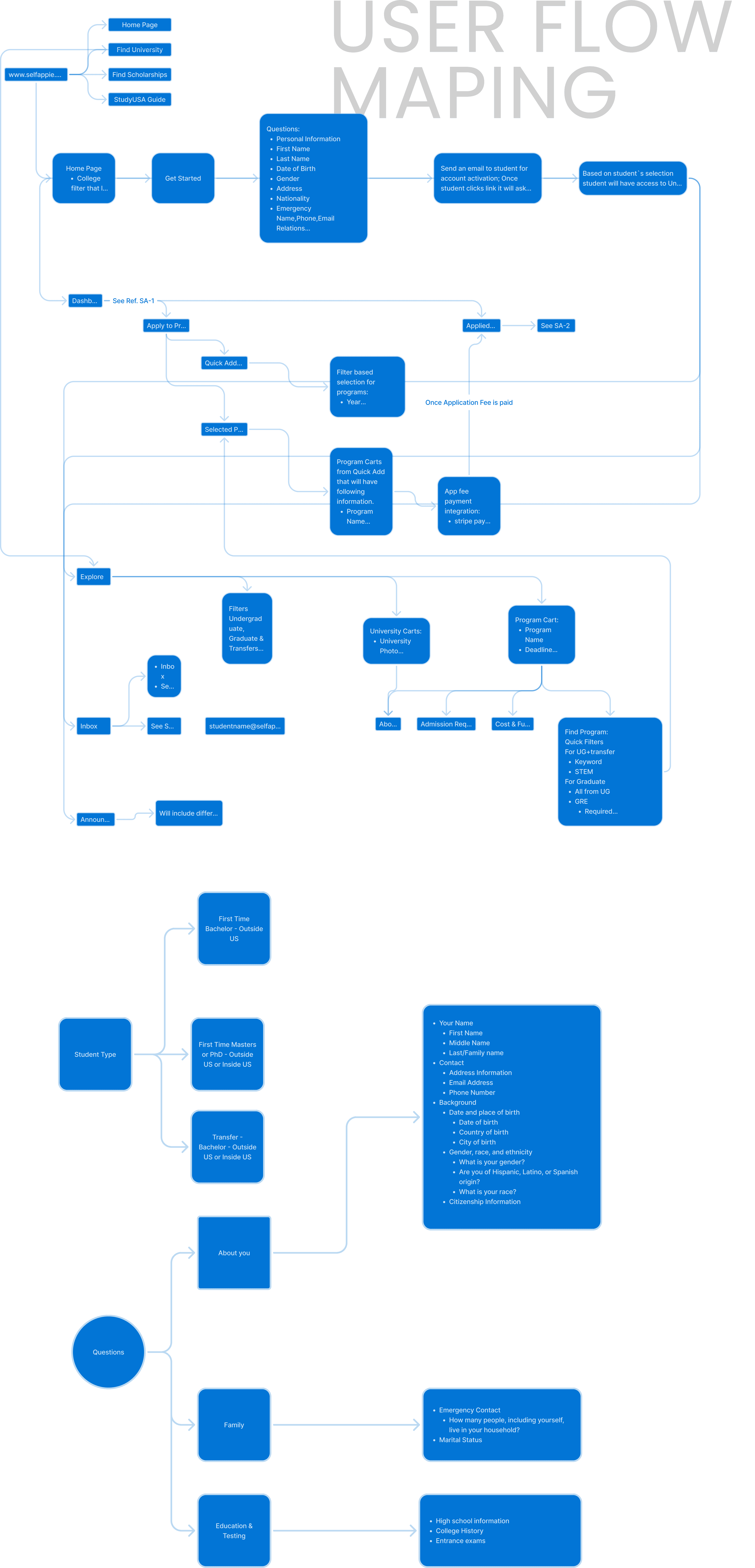
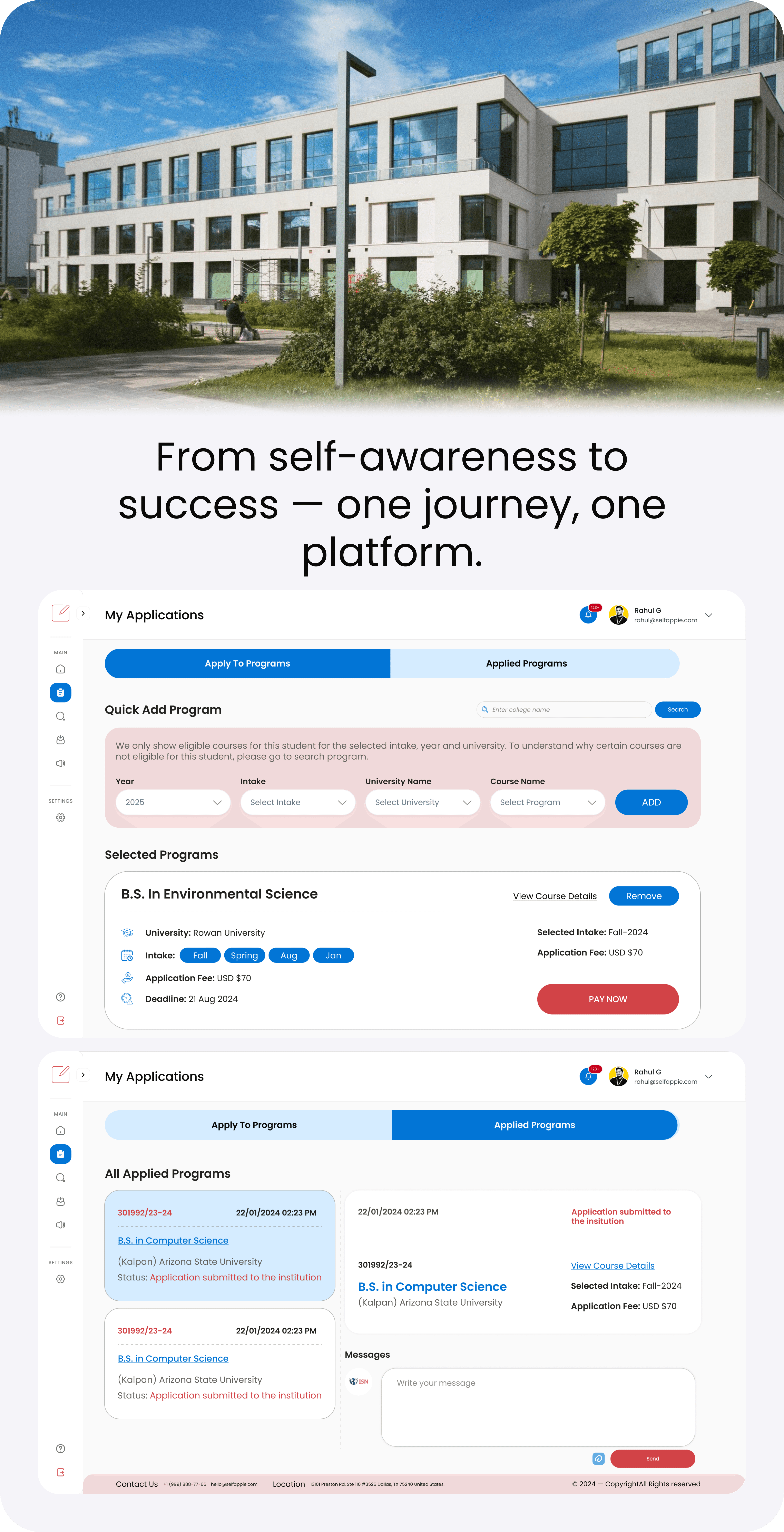
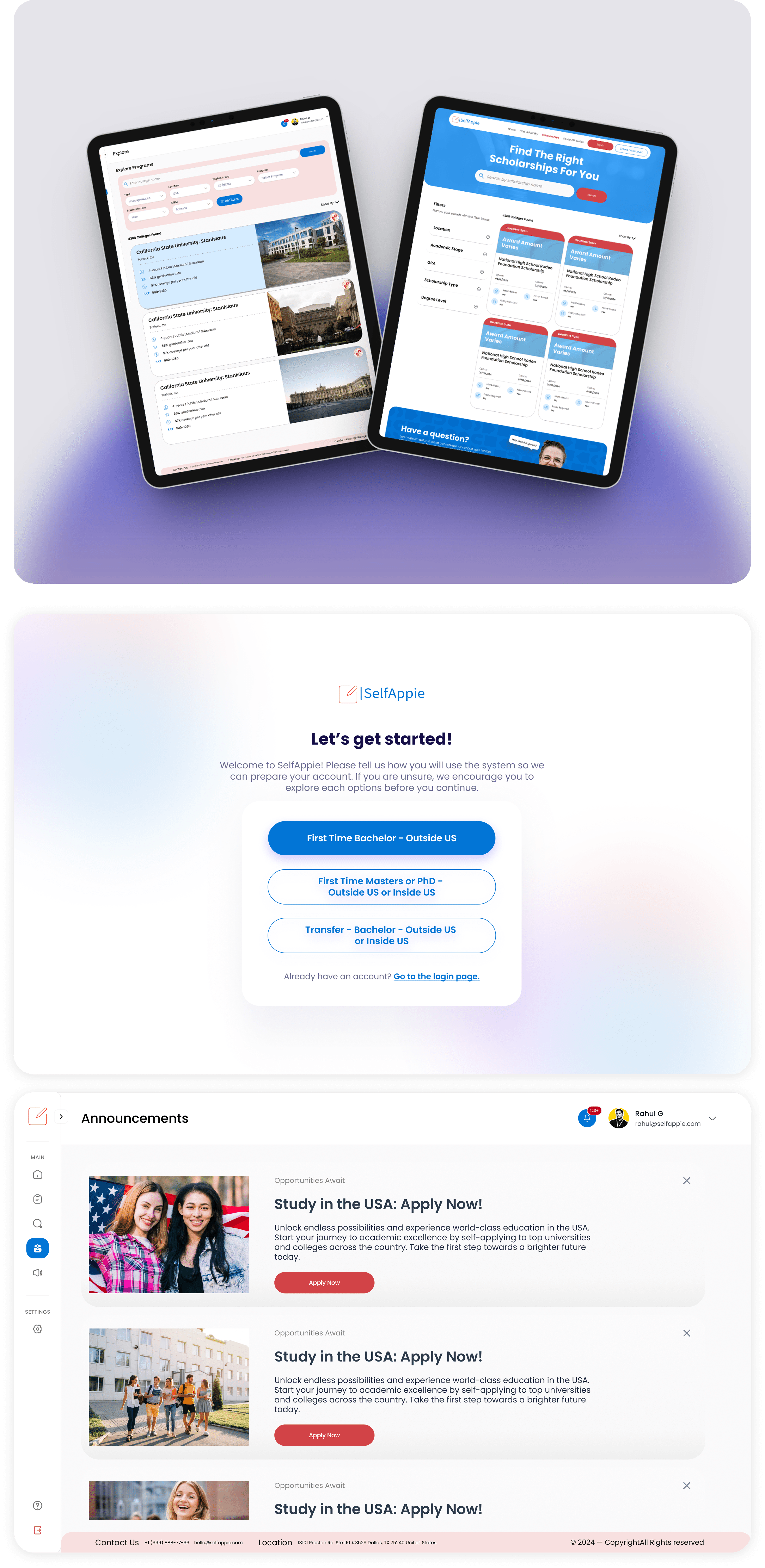
A full EdTech web app covering six interconnected modules, a landing page with university and scholarship discovery, a guided self-assessment and simulation flow, a personalised program recommendation engine, a complete application portal with multi-currency payment integration (Stripe for international students, Nepali online payment for Nepali students), an inbox and announcement system, and a filter-and-track dashboard for monitoring application and scholarship status.
Key design decisions
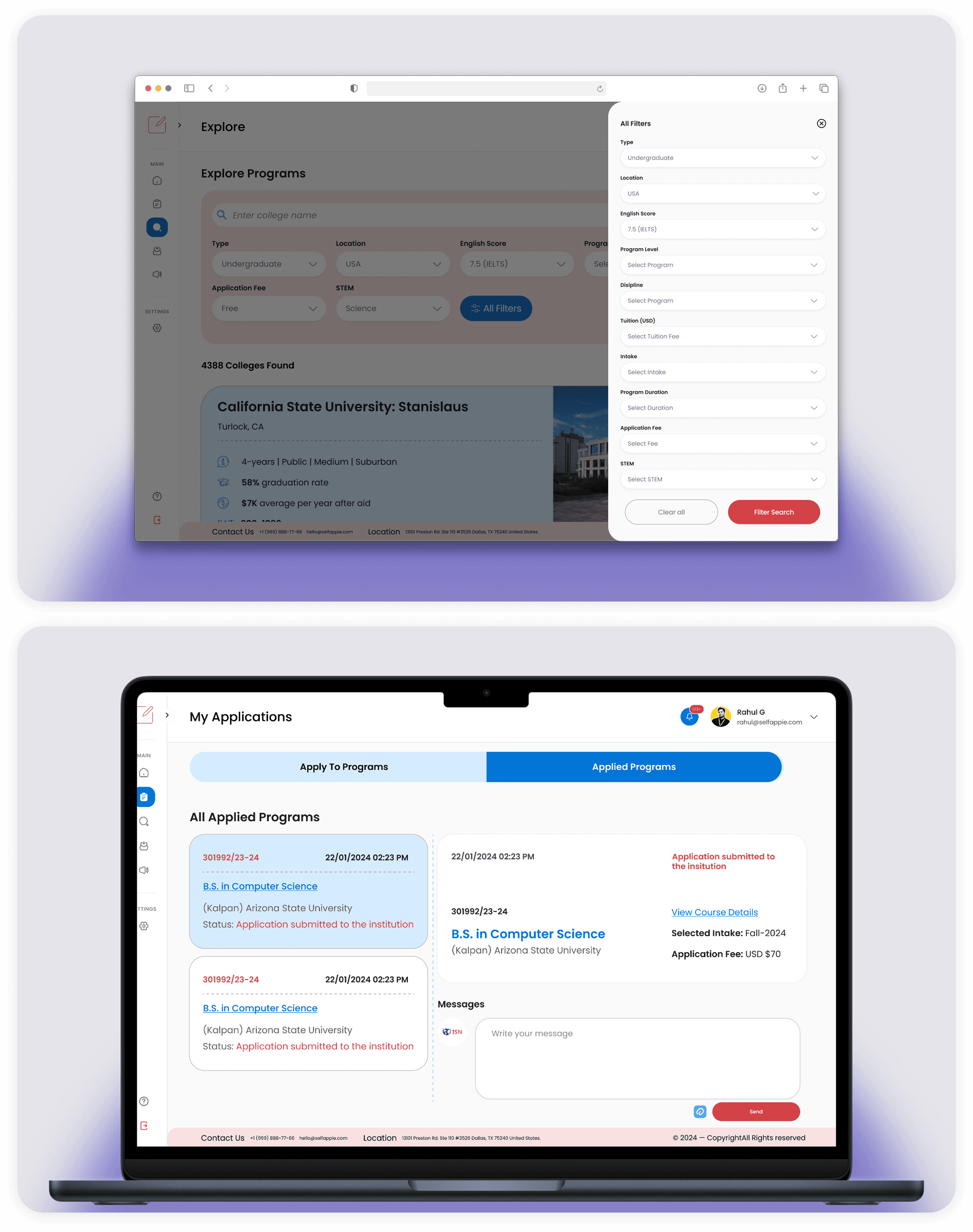
1. Three-step financial simulation as a trust-builder. The simulation flow, UCSC Net Price Calculator to FAID Calculator to Actual Award Letter, was designed as a sequential revelation, not a comparison table. Each step was framed to move the student from uncertainty toward confidence, with the final Award Letter validating the simulation's accuracy. That validation moment was the highest-trust touchpoint in the entire platform. 2. Keyword and criteria-based program filtering built into discovery. University and program search used combined filters, year, intake, university name, course name, location, English score, application fee, STEM status, that matched how students actually narrow their options, not how university databases are organised. The distinction matters: a student doesn't think "I want universities in this state," they think "I need a STEM program with no GRE requirement and an application fee under $100." 3. Unified dashboard from first application to final status. Once a student selects and pays for a program, the dashboard tracks the full application lifecycle in one view, applied programs, quick-add program carts, inbox communications, and progress status. No switching between platforms, no re-entering context. The application journey ends where the discovery journey started.

Results & Impact
Quantitative results
Full seven-stage user journey designed and validated, from first visit through awareness, input, simulation, decision, human support, and future action. Three-step financial simulation flow built and tested against real financial aid tools. Complete application portal covering undergraduate, graduate, and transfer pathways with dual-currency payment integration.
Qualitative outcomes
User journey testing confirmed the platform resolved the three core pain points from research, complexity, lack of personalisation, and disjointed tools. The financial simulation flow produced the clearest positive emotional shift of any feature tested, students moved from discouragement to relief within the FAID step. The unified dashboard was described as "finally feeling like one process instead of ten" in feedback sessions.
Business impact
SelfAppie launches as a platform with a genuine market gap behind it, no existing tool for international students combines self-assessment, financial simulation, program discovery, and application management in a single experience. The design positions SelfAppie not as another university search tool, but as the platform that accompanies a student through the entire decision and application process, which is a fundamentally stronger retention and monetisation position.
Next Steps
What's next (and why)
The platform is pre-launch and the first priority post-launch should be monitoring where students drop off in the simulation flow and application journey. The seven-stage journey map predicts the friction points, but real usage data will show which ones are actually causing abandonment versus which ones are just moments of hesitation that the design handles well enough.
Open questions / hypotheses
Does the three-step simulation flow build enough trust for students to complete the full application, or does the gap between simulation and real application still feel too large? And how does the platform perform for students whose financial situation falls outside the parameters the simulation handles cleanly, are they served well enough, or do they need a clearer escalation path to human support?
Learnings
SelfAppie reinforced something I think about on every EdTech project, emotional design isn't a layer on top of functional design, it's embedded in it. The moment a student feels understood by a platform is a specific, designable moment. In SelfAppie's case it was the FAID Calculator step, a data tool, not a UI flourish, that created the highest emotional impact in the entire experience. Function built with empathy in mind is what makes EdTech actually work.